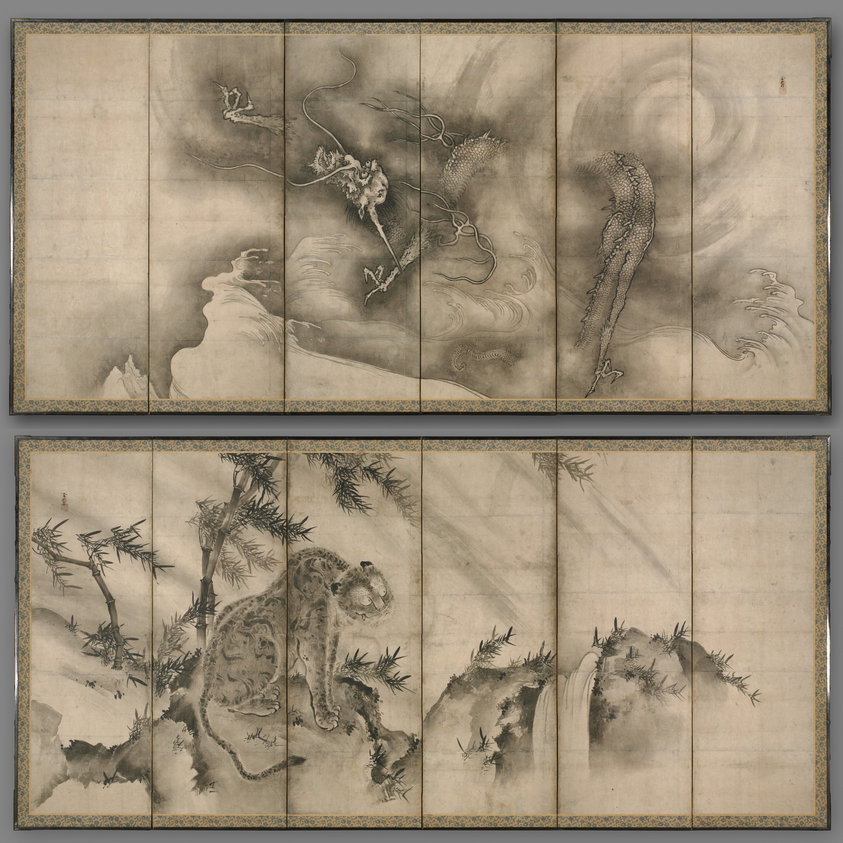
Dragon and Tiger
A tiger sits in a bamboo grove whipped with fierce wind, while a dragon claws through clouds above rough waves. Tiger and dragon are Chinese cosmological symbols of the balancing forces in the world, yin (the feminine aspect) and yang (the masculine aspect). The tiger's roar is also said to generate wind, and the dragon clouds. The screens may have originally been meant to express the fluctuating nature of the world as envisioned in the practice of military divination, or forecasting, based on the Yijing (Book of Changes).
Details
- Palette
-
Select a color to find related artworks.
- Dimensions
- each: height 1.573 m, width 3.39 m; framed: height 1.723 m, width 3.54 m
- Department
- Japanese Art
- Holding institution
- Cleveland Museum of Art
- Image provider
- cleveland-museum-of-art
- License
- CC0-1.0
- Credit
- Purchase from the J. H. Wade Fund
Art Genome Taxonomy
12 tags
Subject Matter
-
Animals Visual · 99%
A tiger is prominently depicted on the lower screen, while a dragon occupies the upper screen.
-
Hybrids and Imaginary Creatures Visual · 99%
The upper screen contains a long, scaled, clawed, serpentine dragon, an imaginary creature rather than a natural animal.
-
Flora Visual · 99%
Bamboo stalks and leaves are a major compositional element around the tiger and extend across the lower screen.
-
Water Visual · 95%
The upper screen contains curling waves, and the lower screen includes a waterfall-like cascade and watery landscape passages.
-
Symbolic Composition Metadata · 94%
The museum describes the tiger and dragon as Chinese cosmological symbols of the balancing forces of yin and yang.
Medium and Techniques
-
East Asian Ink-and-Wash Painting Both · 99%
The museum identifies the work as ink on paper, and the image shows monochrome ink washes with fluid brush lines and tonal modulation.
-
Work on Paper Metadata · 99%
The canonical medium is recorded as ink on paper.
-
Screen Format Metadata · 99%
The work is explicitly described as a pair of six-panel folding screens.
-
Painting Both · 99%
The object is cataloged as a painting, and the image visibly presents painted ink imagery on paper.
-
Large Brushstrokes/Loose Brushwork Visual · 91%
Broad washes and freely varied contour strokes describe the clouds, waves, rocks, bamboo, and animals.
Time Periods
-
16th Century Art Metadata · 98%
The museum dates the work to approximately 1546–1556.
Geographic Regions
-
Japanese Art Metadata · 99%
The artist is identified as Japanese, and the work originated in Japan.
Source & rights
Sesson Shūkei (Japanese, c. 1492–c. 1577). Dragon and Tiger. Cleveland Museum of Art.