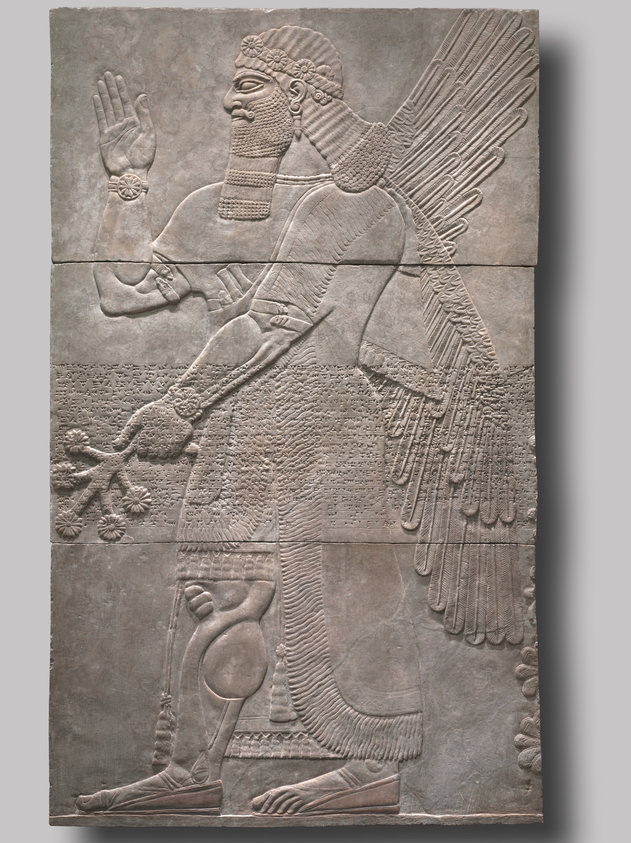
Saluting Protective Spirit
Striding forward with muscular arms and legs, this winged deity offers a gesture of salutation along with symbols of agricultural bounty. Inscribed with an account of the Assyrian king Ashurnasirpal II's military conquests and victories, this relief once stood alongside hundreds of similar ones that decorated the palace at Nimrud.
Details
- Palette
-
Select a color to find related artworks.
- Medium
- gypsum
- Dimensions
- overall: height 2.299 m, width 1.37 m
- Origin
- Neo-Assyrian (911–609 BCE), Iraq, Nimrud, Northwest Palace, reign of Ashurnasirpal II (883–859 BCE)
- Department
- Egyptian and Ancient Near Eastern Art
- Holding institution
- Cleveland Museum of Art
- Image provider
- cleveland-museum-of-art
- License
- CC0-1.0
- Credit
- Purchase from the J. H. Wade Fund
Art Genome Taxonomy
12 tags
Subject Matter
-
Deities and Holy Figures Both · 98%
The catalog describes a winged deity and the image clearly shows a monumental supernatural winged figure.
-
War and Military Metadata · 95%
The inscription records the military conquests and victories of the Assyrian king Ashurnasirpal II.
-
Human Figure Visual · 99%
A fully formed human-like figure occupies most of the relief, with visible head, torso, arms, and legs.
-
Flora Both · 91%
Vegetal and floral motifs are clearly visible, and the catalog describes symbols of agricultural bounty.
-
Text Both · 98%
Dense bands of incised signs visibly cover the lower and central portions of the relief, while the catalog confirms that the work is inscribed.
Visual Qualities
-
Highly Detailed Visual · 98%
Repeated feather, curl, pleat, rosette, and inscription patterns produce an extensively detailed surface.
Medium and Techniques
-
Sculpture Metadata · 99%
The museum classifies the work as sculpture.
-
Relief Both · 99%
The image shows a figure projecting from a flat slab, and the catalog describes the work as a palace relief.
-
Carving Visual · 96%
The raised figure, wings, ornaments, vegetal forms, and inscription are rendered through incised and projecting forms in a solid slab.
Time Periods
-
Ancient Art Metadata · 99%
The museum dates the work to 883–859 BCE, placing it within ancient art.
Geographic Regions
-
Iraqi Art Metadata · 99%
The stated place of origin is Nimrud in present-day Iraq.
Cultural and Religious Styles
-
Mesopotamian Art Metadata · 97%
The work is identified as Neo-Assyrian and originated at Nimrud, an ancient Mesopotamian site.
Source & rights
Unknown artist. Saluting Protective Spirit. Cleveland Museum of Art.