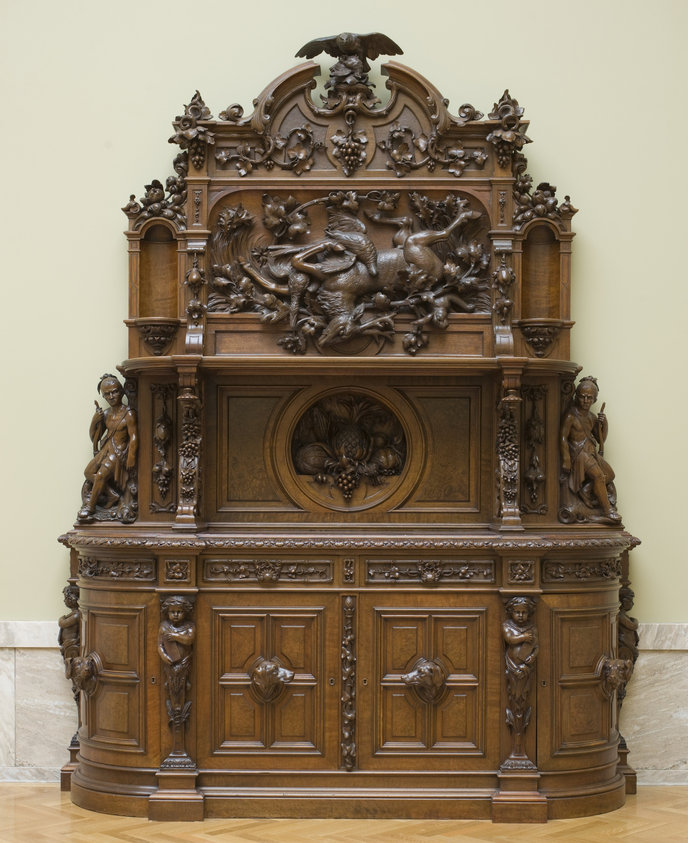
Sideboard
Joseph Alexis Bailly (attributed)
Newly acquired wealth from railroad production, manufacturing, and an expanded economy produced a new elite class of Americans who looked abroad for sources of decoration to adorn their lives. Grand, baronial furniture, reminiscent of German hunting lodges or French castles, became popular during the mid 1800s among America’s wealthy. Elaborate displays of abundance were reflected in the carvings of flora, fauna, and freshly hunted game. The depictions of Native American hunters on this example, most likely made in Philadelphia, may have meant that this piece was displayed at one of the man...
Details
- Palette
-
Select a color to find related artworks.
- Medium
- walnut
- Dimensions
- overall: height 2.904 m, width 2.114 m, depth 0.694 m
- Department
- Decorative Art and Design
- Holding institution
- Cleveland Museum of Art
- Image provider
- cleveland-museum-of-art
- License
- CC0-1.0
- Credit
- Purchase from the J. H. Wade Fund
Art Genome Taxonomy
11 tags
Subject Matter
-
Animals Both · 99%
Birds and other game animals are prominent in the central relief and appear elsewhere as carved ornament; the museum description specifically mentions fauna and freshly hunted game.
-
Flora Both · 99%
Leaves, vines, grapes, fruit, and other botanical forms recur across the façade, matching the museum’s description of carved flora.
-
Human Figure Both · 92%
Human figures are visibly incorporated into the side supports and lower front; the museum’s subject metadata lists male, while its description refers to Native American hunters.
Visual Qualities
-
Symmetrical Visual · 99%
The façade is organized around a central vertical axis, with balanced architectural divisions, paired figures, and repeated ornamental elements on either side.
-
Highly Ornamented Visual · 99%
Nearly every visible section is embellished with layered moldings, scrollwork, foliage, fruit, animals, and figural carving.
Medium and Techniques
-
Carving Visual · 99%
The façade is extensively carved, including foliage, fruit, birds, game, human figures, moldings, and architectural ornament.
-
Relief Visual · 97%
Many carved elements project substantially from the cabinet surface, especially the central game scene, figural supports, animals, fruit, and ornamental foliage.
Time Periods
-
19th Century Art Metadata · 99%
The museum dates the work to circa 1855, placing it in the 19th century.
Geographic Regions
-
American Art Metadata · 94%
The artist is identified as American, and the recorded place of origin is America, Pennsylvania, Philadelphia?
Materials
-
Wood Both · 99%
The museum specifies walnut as the medium; the image visibly shows a continuous brown wooden surface and wooden construction.
Furniture and Lighting
-
Sideboard Both · 99%
The museum identifies the work as a sideboard, and the image shows a large cabinet intended for storage and display, with doors, compartments, and a broad superstructure.
Source & rights
Joseph Alexis Bailly (American, 1825–1883). Sideboard. Cleveland Museum of Art.