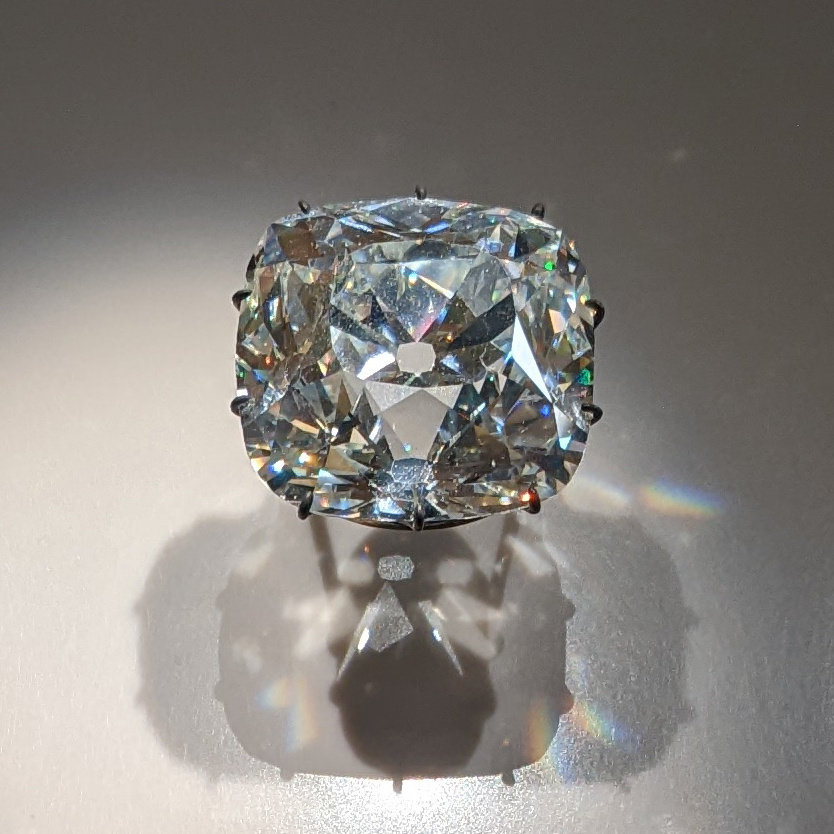
Diamant, dit "le Régent"
Le Regent est un diamand facetté de forme coussin rectangulaire, épais, épais, gemme presque net, facetté sur ses deux côtés en brillant taille ancienne, presque incolore, à peine teinté de bleu-vert. Cette pierre fut découverte en 1698 dans les mines de Golconde, en Inde, et suscita immédiatement l'intérêt de Thomas Pitt, gouverneur anglais de Madras. Le diamant fut taillé en Angleterre puis acquis à la demande du régent Philippe d'Orléans en 1717. Le Régent surpassait en beauté et en poids tous les diamants jusqu'alors connus en Occident. Aujourd'hui encore, il est considéré comme le plus...
Details
- Palette
-
Select a color to find related artworks.
- Medium
- Matériau : diamant
- Dimensions
- Hauteur 3,2 cm; Largeur 3,1 cm
- Holding institution
- Musée du Louvre
- Image provider
- wikimedia-commons
- License
- CC0
- Credit
- Musée du Louvre, Département des Objets d'art du Moyen Age, de la Renaissance et des temps modernes
Art Genome Taxonomy
9 tags
Artistic Disciplines
-
Jewelry Metadata · 98%
The Louvre classifies the object as a jewel or parure and identifies it as the diamond known as “the Regent.”
Subject Matter
-
Royalty and Aristocracy Metadata · 94%
The catalog records the diamond’s acquisition for Philippe d’Orléans and its later use in French royal and imperial crowns, swords, and regalia.
Visual Qualities
-
Geometric Visual · 98%
The stone has a strongly organized rounded-rectangular cushion outline and numerous angular planar facets.
-
Shiny/Glossy Visual · 99%
Polished facets generate intense highlights, reflections, and sharp flashes of light across the stone.
-
Highly Detailed Visual · 95%
The image is dominated by numerous finely differentiated facets and internal reflections.
-
Transparent/Translucent Medium Both · 94%
The stone appears visibly transparent or translucent, consistent with the catalog’s identification of it as a diamond.
-
Single Object Visual · 98%
One central jewel is isolated against a neutral display background.
Time Periods
-
18th Century Art Metadata · 96%
The catalog dates the cutting or fabrication to 1704–1706, within the eighteenth century.
Materials
-
Gemstone Both · 100%
The catalog identifies the material as diamond, and the image visibly shows a large transparent, faceted gemstone.
Source & rights
Shonagon. Own work