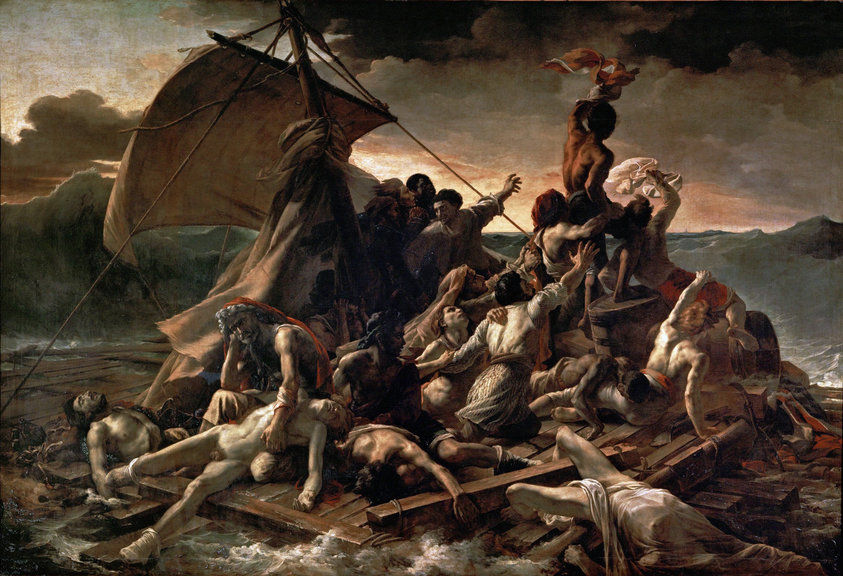
Le radeau de la Méduse
La frégate "La Méduse", ayant à bord quatre cents hommes, marins, soldats, passagers civils, devait se rendre à Saint-Louis du Sénégal. Elle n'atteint jamais son but car elle s'échoue le 2 juillet 1816 dans le banc d'Arguin, un grand banc de sable immergé situé au large des côtes sénégalaises. Ne parvenant pas à dégager le bateau, les membres d'équipage fabriquent un radeau à partir de débris de la frégate. Cent-cinquante personnes prennent place à bord de cette embarcation de fortune. Le radeau devait être remorqué jusqu'au rivage par les chaloupes commandées par le capitaine, mais les cor...
Details
- Palette
-
Select a color to find related artworks.
- Medium
- huile sur toile
- Dimensions
- Hauteur 4,91 m; Largeur 7,16 m
- Department
- Département des Peintures
- Holding institution
- Musée du Louvre
- Image provider
- wikimedia-commons
- License
- Public domain
- Credit
- Musée du Louvre, Département des Peintures
Art Genome Taxonomy
12 tags
Subject Matter
-
Disaster Both · 99%
The metadata describes the Méduse shipwreck, abandonment, and disastrous drift, while the image shows a damaged raft, rough sea, collapsed bodies, and desperate survivors.
-
Mortality Both · 98%
The metadata records the drastic loss of life during the raft's ordeal, and apparently lifeless bodies occupy much of the foreground.
-
Narrative Both · 98%
The metadata supplies a specific sequence of wreck, abandonment, drifting, and rescue; the image stages a climactic moment in which survivors signal toward a distant vessel.
-
Waterscapes Both · 97%
The work's subject is a raft adrift at sea, and the image visibly depicts open water, breaking waves, a horizon, and a storm-filled sky.
-
Human Figure Visual · 99%
Numerous prominently modeled human bodies fill the composition in varied poses, including reclining, crouching, standing, reaching, and gesturing figures.
Styles and Movements
-
Romanticism Interpretive · 88%
The attribution is an art-historical inference based on the work's early nineteenth-century context, catastrophic subject, heightened emotion, dramatic diagonals, turbulent nature, and strong contrasts of light and shadow; the supplied catalog does not provide a formal style classification.
Visual Qualities
-
Dense Composition Visual · 99%
Overlapping bodies, timber planks, sailcloth, ropes, and rigging occupy most of the pictorial surface with little unoccupied space.
-
Dynamism Visual · 98%
Angled limbs, ropes, mast lines, swelling waves, and the collective movement toward the horizon create a strongly directional and unstable composition.
Medium and Techniques
-
Oil Painting Metadata · 100%
The catalog specifies huile sur toile, or oil on canvas.
-
Large-Scale Painting Both · 99%
The catalog gives monumental dimensions of 4.91 by 7.16 meters, and the image presents a broad, densely populated pictorial field.
Time Periods
-
19th Century Art Metadata · 100%
The metadata dates the work to 1818–1819.
Geographic Regions
-
French Art Metadata · 98%
The artist metadata identifies Géricault with France, and the work is held by the Musée du Louvre.
Source & rights
Théodore Géricault. Unknown source