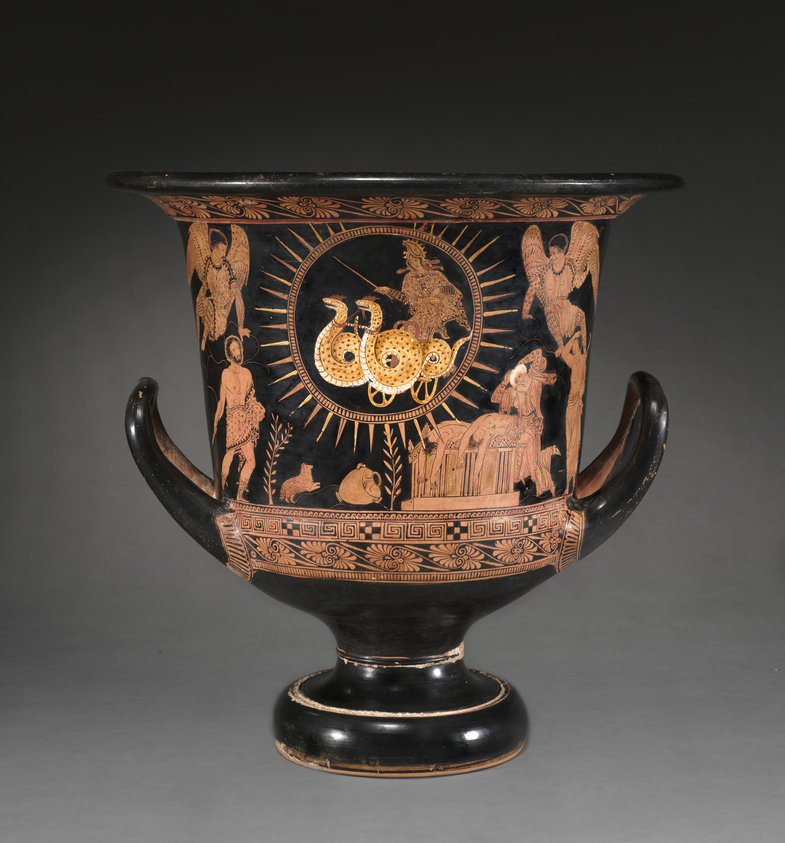
Red-Figure Calyx-Krater (Mixing Vessel): Medea in Chariot (A); Telephos with Baby Orestes (B)
The remarkable scene on the front of this vase relates to the famous tragedy Medea, written by Euripides and first produced in Athens in 431 BC. Framed in the center by a halo (recalling her sun god grandfather Helios), the sorceress Medea flies off in a dragon-drawn chariot. Seeking revenge against her husband Jason, leader of the Argonauts, Medea has just slain their two children. Two Furies flank her, while Jason and a distraught nurse and teacher approach the bodies on the altar below. A different tragedy unfolds on the other side of the vase, from Euripides’s Telephos (438 BC). The wou...
Details
- Palette
-
Select a color to find related artworks.
- Medium
- ceramic
- Dimensions
- diameter of mouth: width 0.499 m; overall: height 0.505 m; diameter of foot: width 0.22 m
- Origin
- South Italian, Lucanian
- Department
- Greek and Roman Art
- Holding institution
- Cleveland Museum of Art
- Image provider
- cleveland-museum-of-art
- License
- CC0-1.0
- Credit
- Leonard C. Hanna Jr. Fund
Art Genome Taxonomy
12 tags
Subject Matter
-
Classical Mythology Metadata · 99%
The museum identifies Medea, Jason, the Furies, Telephos, Agamemnon, Clytemnestra, and Orestes in mythological scenes drawn from Euripidean tragedy.
-
Violence Metadata · 98%
The catalog explicitly describes Medea’s killing of her two children and Telephos holding the infant Orestes hostage.
-
Narrative Metadata · 98%
The vessel depicts two identifiable tragic episodes, one on each side, from Euripides’ Medea and Telephos.
Visual Qualities
-
Highly Ornamented Visual · 98%
The visible side contains dense figural decoration framed by repeated floral borders, patterned garments, and multiple ornamental registers.
-
Patterns Visual · 99%
Repeated floral scrolls, meanders, radiating lines, and other geometric and vegetal motifs organize the surface.
-
Radiating Lines Visual · 98%
Long rays visibly radiate from the circular central scene, creating a strong radial emphasis.
Medium and Techniques
-
Painting Both · 94%
The vessel is covered with painted figural and ornamental decoration; the catalog identifies it as a red-figure vessel.
Time Periods
-
Ancient Art Metadata · 99%
The work is dated approximately 400 BCE.
Geographic Regions
-
Italian Art Metadata · 87%
The place of origin is recorded as South Italian, Lucanian.
Materials
-
Ceramic Both · 99%
The catalog classifies the object as ceramic, and the image shows a fired pottery vessel with a bowl, handles, stem, and foot.
Cultural and Religious Styles
-
Greek and Roman Art and Architecture Metadata · 96%
The museum classifies the work within Greek and Roman Art, and its imagery derives from Greek tragedies.
Tableware, Vessels, and Objects
-
Vessel Metadata · 99%
The museum identifies the object as a red-figure calyx-krater, explicitly described as a mixing vessel.
Source & rights
Policoro Painter (South Italian, Lucanian, active c. 400 BCE). Red-Figure Calyx-Krater (Mixing Vessel): Medea in Chariot (A); Telephos with Baby Orestes (B). Cleveland Museum of Art.