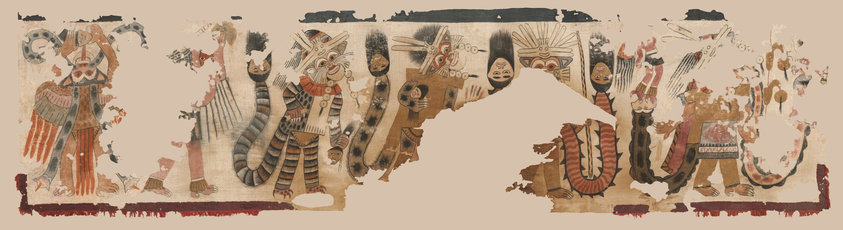
Cloth with Procession of Figures
Experts agree that this cloth is one of the greatest paintings to survive from Andean antiquity due to the realism, complexity, large size, and refined execution of its figures. All but one of the figures wear the whiskered mouth mask of Nasca supernatural beings and several carry or wear severed human heads, which the Nasca linked to nature’s fruitfulness. Thus, the figures seem to represent supernatural forces or humans personifying such forces during a ritual devoted to agricultural fertility. Originally, the panel was attached along its upper edge to a dark blue cloth of equal size. The...
Details
- Palette
-
Select a color to find related artworks.
- Dimensions
- overall: height 0.698 m, width 2.807 m; mounted: height 0.787 m, width 2.902 m
- Department
- Textiles
- Holding institution
- Cleveland Museum of Art
- Image provider
- cleveland-museum-of-art
- License
- CC0-1.0
- Credit
- The Norweb Collection
Art Genome Taxonomy
12 tags
Subject Matter
-
Mythology and Religion Both · 93%
The museum discusses Nasca supernatural beings and a possible ritual context; the image shows numerous masked and elaborately headdressed figures that are visually distinct from ordinary portraiture.
-
Fertility/Pregnancy/Birth Metadata · 94%
The museum explicitly relates the imagery to nature’s fruitfulness and a possible ritual devoted to agricultural fertility.
-
Human Figure Visual · 99%
The surviving pictorial field contains numerous standing or walking anthropomorphic figures distributed along the length of the cloth.
-
Body Parts Both · 90%
Small head-like forms are visibly carried or attached to several figures, and the museum identifies several of these as severed human heads.
Visual Qualities
-
Highly Detailed Visual · 96%
The remaining figures contain finely rendered masks, facial features, headdresses, patterned garments, appendages, and subsidiary forms despite the textile’s losses.
-
Patterns Visual · 96%
Stripes, dots, bands, and repeated geometric or curving motifs are visible across the figures’ garments and accessories.
Medium and Techniques
-
Painting Both · 95%
The image shows colored pictorial forms applied across the cloth, while the museum describes the object as a major painting and identifies pigment as part of its medium.
Time Periods
-
Ancient Art Metadata · 99%
The radiocarbon date of 170 BCE–70 CE places the work in antiquity.
Geographic Regions
-
Andes Region Art Metadata · 99%
The documented place of origin is the South Coast of the Central Andes and the makers are identified as the Nasca people.
Materials
-
Natural Fibers Metadata · 98%
The museum identifies cotton in the field and camelid fiber in the borders and fringe; the image visibly shows a cloth support and fibrous fringe, although the fibers cannot be confirmed from the image alone.
Cultural and Religious Styles
-
Pre-Columbian Art Metadata · 99%
A Nasca work dated to 170 BCE–70 CE is unambiguously pre-Columbian, and the museum identifies its cultural origin as the Nasca people of the Central Andes.
Textiles
-
Textile Arts Both · 99%
The museum classifies the object as a textile, and the image shows painted imagery on a flexible cloth support with woven borders and fringe.
Source & rights
Unknown artist. Cloth with Procession of Figures. Cleveland Museum of Art.