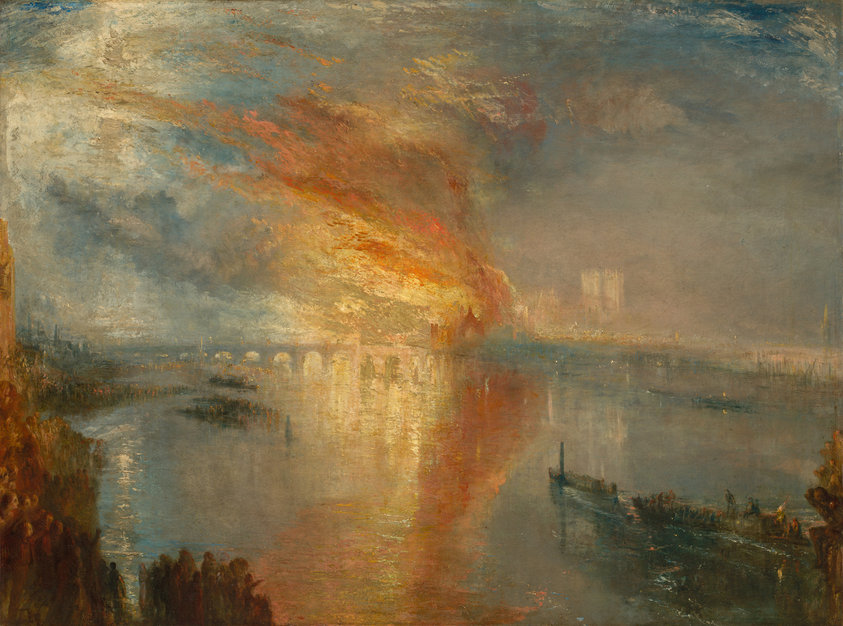
The Burning of the Houses of Lords and Commons, 16 October 1834
Fire consumed London’s famous Houses of Parliament on the night of October 16, 1834, and people gathered along the banks of the river Thames to gaze in awe at the horrifying spectacle. Initially, a low tide made it difficult to pump water to land and hampered steamers towing firefighting equipment along the river. The blaze burned uncontrollably for hours.J. M. W. Turner records the struggle as the boats in the lower-right corner head toward the flames. Although Turner based the painting on an actual event, he magnified the height of the flames, using the disaster as the starting point to e...
Details
- Palette
-
Select a color to find related artworks.
- Medium
- oil on canvas
- Dimensions
- framed: height 1.235 m, width 1.535 m, depth 0.12 m; unframed: height 0.92 m, width 1.232 m
- Origin
- England, 19th century
- Department
- Modern European Painting and Sculpture
- Holding institution
- Cleveland Museum of Art
- Image provider
- cleveland-museum-of-art
- License
- CC0-1.0
- Credit
- Bequest of John L. Severance
Art Genome Taxonomy
12 tags
Subject Matter
-
Disaster Both · 99%
The museum identifies the subject as the October 16, 1834 fire that consumed London’s Houses of Parliament, while the image visibly centers on a vast blaze and smoke plume.
-
Landscapes and Waterscapes Both · 98%
The composition is dominated by the River Thames, reflective water, distant banks, and atmospheric sky; the museum description identifies spectators gathered along the Thames.
-
Crowds Both · 94%
A group of onlookers is visible along the lower-left bank, and the museum specifically describes people gathering to watch the fire.
-
Modes of Transportation Both · 90%
Several boats are visible on the river, including in the lower-right area, and the museum describes boats heading toward the flames.
-
Cityscapes and City Scenes Both · 83%
Distant architectural forms appear across the river, while the title and museum metadata identify the setting as London’s Houses of Parliament.
-
Light as Subject Visual · 96%
The fire’s intense yellow, orange, and red illumination spreads through the smoke and across the broad reflection in the water, making light a central visual force.
-
The Sublime Both · 88%
The immense fire and turbulent atmosphere overwhelm the comparatively small spectators and boats; the museum describes the event as an awe-inspiring spectacle and connects it with human helplessness before destructive forces.
Visual Qualities
-
Bright and Vivid Colors Both · 94%
Brilliant orange, red, yellow, and gold passages around the blaze contrast strongly with blue-gray water and smoke; the museum also describes brilliant swathes of color.
Medium and Techniques
-
Oil Painting Both · 99%
The museum specifies oil on canvas, and the image visibly presents a painted surface with layered, blended pigment.
-
Large Brushstrokes/Loose Brushwork Visual · 87%
Loose directional strokes and softened, rubbed passages articulate the fire, smoke, reflections, and distant architecture without sharply defined contours.
Time Periods
-
19th Century Art Metadata · 99%
The museum dates the work to 1835, placing it in the nineteenth century.
Geographic Regions
-
British and Irish Art Metadata · 98%
The museum identifies Turner as British and gives the place of origin as England.
Source & rights
Joseph Mallord William Turner (British, 1775–1851). The Burning of the Houses of Lords and Commons, 16 October 1834. Cleveland Museum of Art.