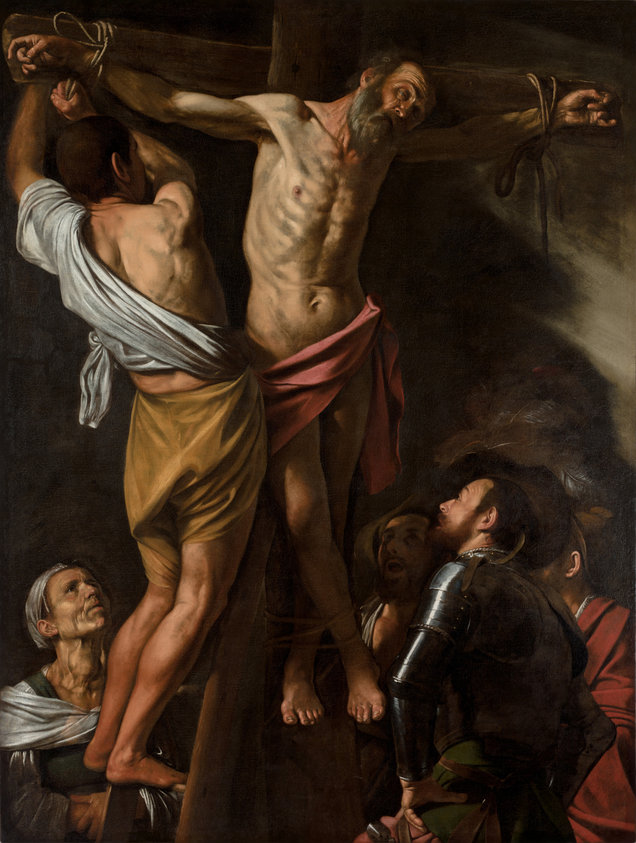
The Crucifixion of Saint Andrew
Saint Andrew’s efforts to introduce Christianity to Greece in the first century CE were met with hostility from local authorities. He was sentenced to die on the cross because he refused to acknowledge pagan gods. For two days, Andrew preached from his martyr’s station to an increasingly sympathetic crowd. Bowing to public demand, Andrew’s would-be executioners attempted to untie him, but their hands were mysteriously paralyzed. Andrew’s desire for martyrdom was thus fulfilled and he died enveloped in divine light. Caravaggio’s innovative interpretation involves the viewer more closely in t...
Details
- Palette
-
Select a color to find related artworks.
- Medium
- oil on canvas
- Dimensions
- framed: height 2.335 m, width 1.84 m, depth 0.12 m; unframed: height 2.025 m, width 1.527 m
- Origin
- Italy, Naples
- Department
- European Painting and Sculpture
- Holding institution
- Cleveland Museum of Art
- Image provider
- cleveland-museum-of-art
- License
- CC0-1.0
- Credit
- Leonard C. Hanna Jr. Fund
Art Genome Taxonomy
12 tags
Subject Matter
-
Saints Metadata · 99%
The museum identifies the subject as Saint Andrew during his crucifixion and martyrdom.
-
Bible Story Metadata · 95%
The catalog provides a Christian narrative of Saint Andrew’s martyrdom on the cross.
-
Narrative Both · 94%
The work depicts an unfolding act of crucifixion involving the saint, attendants, and observers; the museum description supplies the narrative of the event.
-
Human Figure Visual · 99%
Several anatomically rendered human figures occupy the composition, including the crucified central figure, workers, and observers.
Styles and Movements
-
Baroque Metadata · 99%
The Cleveland Museum of Art explicitly describes the work as a masterpiece of Baroque painting.
Visual Qualities
-
Dark Colors Visual · 98%
The palette is dominated by black, deep brown, and muted shadowed tones, punctuated by warm flesh, white, red, and ocher accents.
Medium and Techniques
-
Chiaroscuro Both · 99%
The painting sets strongly illuminated flesh and fabric against extensive shadow, a contrast also explicitly noted by the museum.
-
Oil Painting Metadata · 99%
The catalog specifies oil on canvas.
-
Painting Metadata · 99%
The museum classifies the object as a painting.
-
Altarpiece Metadata · 97%
The catalog identifies the work as an altarpiece.
Time Periods
-
17th Century Art Metadata · 99%
The date of 1606–7 places the work in the seventeenth century.
Geographic Regions
-
Italian Art Metadata · 98%
The artist is identified as Italian and the place of origin as Italy, Naples.
Source & rights
Caravaggio (Italian, 1571–1610). The Crucifixion of Saint Andrew. Cleveland Museum of Art.