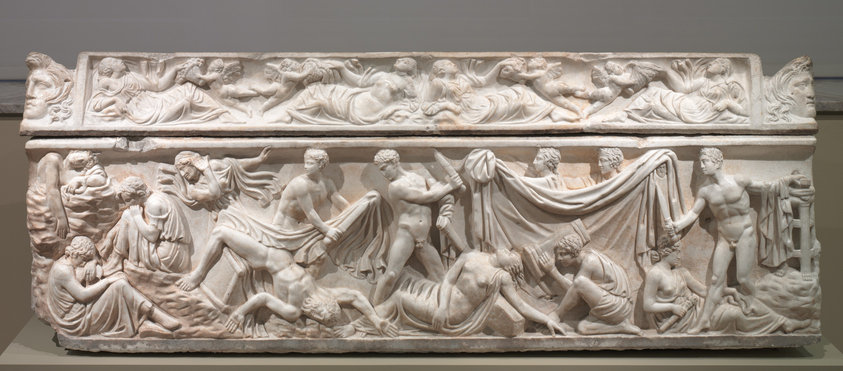
Sarcophagus
The tragic figure Orestes appears three times on the front of this sarcophagus, always wielding a short sword. In the center he stands over the body of his mother Clytemnestra, and at center left over the body of her lover Aegisthus. Orestes has killed them both to avenge their murder of his father Agamemnon, upon his return from years of fighting at Troy. At the far left, three Furies (avenging spirits) rest upon Agamemnon's tomb, while at the far right, Orestes atones for the murders at the Delphian shrine of Apollo, marked by a tripod and rock. On the lid, four reclining women symbolize ...
Details
- Palette
-
Select a color to find related artworks.
- Medium
- Greek marble
- Origin
- Italy, Rome, Roman Empire
- Department
- Greek and Roman Art
- Holding institution
- Cleveland Museum of Art
- Image provider
- cleveland-museum-of-art
- License
- CC0-1.0
- Credit
- Gift of the John Huntington Art and Polytechnic Trust
Art Genome Taxonomy
11 tags
Subject Matter
-
Classical Mythology Metadata · 99%
The museum description explicitly identifies episodes from the myth of Orestes, including the deaths of Clytemnestra and Aegisthus, the Furies, Agamemnon's tomb, and Apollo's shrine.
-
Narrative Both · 98%
Multiple episodes are arranged across a continuous horizontal field, with recurring figures and actions forming a sequential mythological narrative.
-
Violence Metadata · 95%
The catalog description states that Orestes kills Clytemnestra and Aegisthus with a short sword.
Visual Qualities
-
Dense Composition Visual · 98%
The front is tightly filled with overlapping figures, extended limbs, drapery, and attributes across nearly the entire relief field.
-
Highly Detailed Visual · 96%
The carving includes numerous articulated figures, detailed hair and facial features, muscular anatomy, and elaborate drapery folds.
Medium and Techniques
-
Sculpture Both · 100%
The museum classifies the work as sculpture, and the image shows a carved three-dimensional marble sarcophagus with extensive relief decoration.
-
Relief Both · 99%
The front and lid are decorated with figures and drapery carved in raised relief against a comparatively recessed ground.
Time Periods
-
Ancient Art Metadata · 96%
The object is dated circa 100–125 CE, placing it within ancient Roman art.
Materials
-
Marble Metadata · 99%
The museum identifies the medium as Greek marble; the image is consistent with a pale carved stone surface.
Cultural and Religious Styles
-
Greek and Roman Art and Architecture Metadata · 99%
The museum classifies the object within Greek and Roman Art and identifies its origin as Rome in the Roman Empire.
Antiquities, Artifacts, and Religious Objects
-
Funerary/Commemorative Object Metadata · 99%
The title identifies the object as a sarcophagus, a funerary container, and its coffin-like form is clearly visible in the image.
Source & rights
Unknown artist. Sarcophagus. Cleveland Museum of Art.