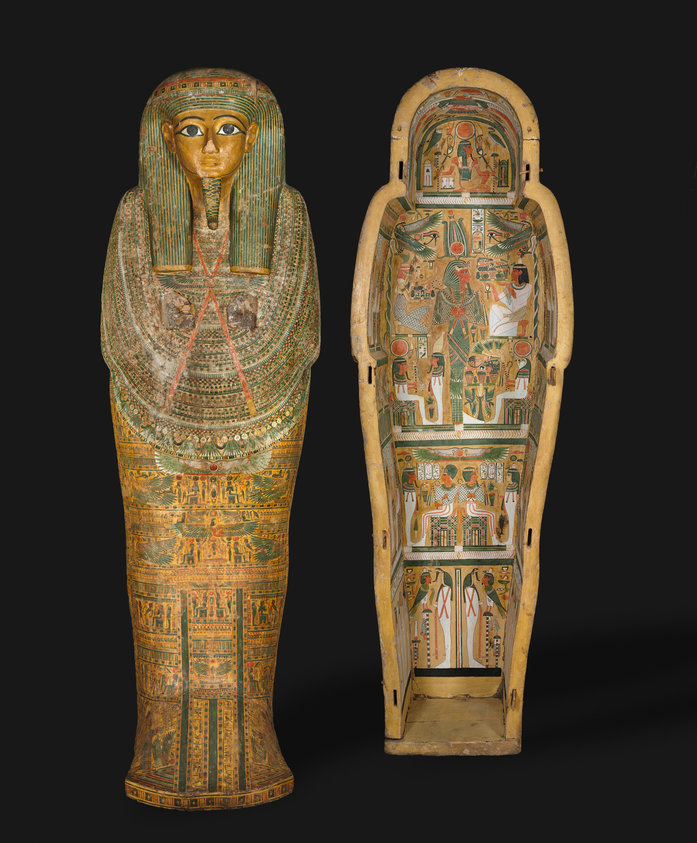
Coffin of Bakenmut
The coffin of Bakenmut is one of the finest examples of painted wooden coffins made for the priests of Amen and their families at Thebes during Dynasty 21 and early Dynasty 22. The pharaohs of this time were no longer buried in the Valley of the Kings, but instead built tombs in the Delta, far to the north, where they resided. Security was lax in the Theban necropolis. The coffins and funerary goods of the wealthy citizens of Thebes were placed in unmarked and undecorated family tombs cut into the cliffs on the west bank of the Nile. All the care and detail that in more prosperous times wer...
Details
- Palette
-
Select a color to find related artworks.
- Dimensions
- overall: height 2.08 m, width 0.68 m
- Department
- Egyptian and Ancient Near Eastern Art
- Holding institution
- Cleveland Museum of Art
- Image provider
- cleveland-museum-of-art
- License
- CC0-1.0
- Credit
- Gift of the John Huntington Art and Polytechnic Trust
Art Genome Taxonomy
11 tags
Subject Matter
-
Mythology and Religion Both · 98%
The catalog describes funerary gods and goddesses, protective spells, magical symbols, and deified kings; the image shows repeated religious figures, emblems, and ritual registers.
-
Mortality Metadata · 98%
As a coffin intended for burial and decorated with funerary imagery, the object is directly associated with mortality and death-related ritual.
Visual Qualities
-
Highly Ornamented Visual · 99%
The visible exterior and interior surfaces are extensively covered with painted bands, figures, symbols, vegetal motifs, and patterned details, leaving little undecorated area.
-
Dense Composition Visual · 99%
Both views are organized as tightly packed registers and compartments containing numerous small figures, emblems, and text-like marks.
-
Symmetrical Both · 92%
The exterior face, collar, braces, and lower registers are arranged around a strong vertical axis, while the interior uses repeated bilateral groupings and a central division.
Medium and Techniques
-
Painting Metadata · 99%
The museum identifies the medium as gessoed and painted sycamore fig and describes the object as a painted wooden coffin.
Time Periods
-
Ancient Art Metadata · 94%
The object is dated circa 1000–900 BCE, within the ancient period.
Geographic Regions
-
Egyptian Art Metadata · 99%
The museum records the place of origin as Egypt, Thebes, and places the object in Egyptian and Ancient Near Eastern Art.
Materials
-
Wood Metadata · 99%
The recorded structural material is sycamore fig wood.
Cultural and Religious Styles
-
Ancient Egypt Both · 99%
The catalog identifies the place of origin as Thebes, Egypt, and the object visibly employs Egyptian funerary imagery, frontal figure conventions, symbolic motifs, and hieroglyphic inscriptions.
Antiquities, Artifacts, and Religious Objects
-
Funerary/Commemorative Object Metadata · 99%
The Cleveland Museum of Art classifies the object as funerary equipment and identifies it specifically as the Coffin of Bakenmut.
Source & rights
Unknown artist. Coffin of Bakenmut. Cleveland Museum of Art.