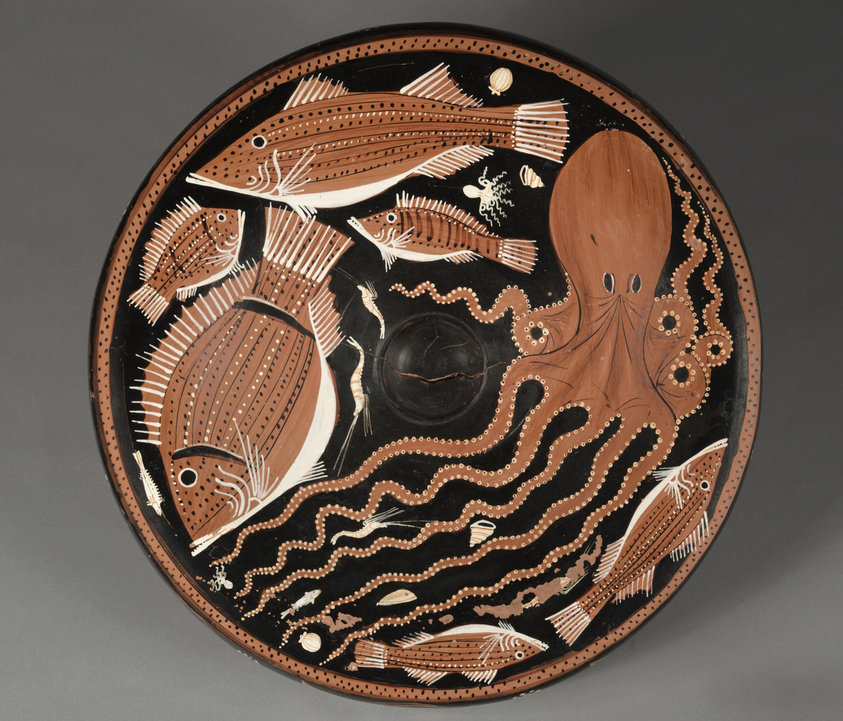
Red-Figure Fish Plate: Octopi, Mullet, Bream, Shellfish
Asteas/Python Workshop (attributed)
Although first developed in Athens, red-figure fish plates became especially popular in South Italy and Sicily in the 300s BC. All feature a short foot and a small central depression, but those produced in the workshop of Asteas and Python, like this one, are the largest and most ornate. Archaeologists have closely studied the fish and other sea creatures represented, identifying many of them with species still found (and eaten) in the Mediterranean; included here are octopi, mullet, bream, and various shellfish.
Details
- Palette
-
Select a color to find related artworks.
- Medium
- ceramic
- Dimensions
- diameter: width 0.383 m; overall: height 0.079 m; diameter of foot: width 0.16 m
- Origin
- South Italian, Paestan
- Department
- Greek and Roman Art
- Holding institution
- Cleveland Museum of Art
- Image provider
- cleveland-museum-of-art
- License
- CC0-1.0
- Credit
- Leonard C. Hanna Jr. Fund
Art Genome Taxonomy
9 tags
Subject Matter
-
Animals Both · 99%
The composition visibly depicts an octopus, several fish, and smaller shellfish or marine forms; the museum description specifically identifies octopi, mullet, bream, and shellfish.
Visual Qualities
-
Dense Composition Visual · 97%
Marine creatures occupy most of the plate’s interior, leaving relatively little undecorated ground beyond the central depression.
-
Patterns Visual · 98%
Repeated dots, linear marks, scale and fin details, tentacle suckers, and dotted rim bands create a strongly patterned surface.
Medium and Techniques
-
Glass and Ceramics Both · 95%
The work is a ceramic object with painted decoration; the catalog identifies ceramic as its medium and this catalog category encompasses ceramic techniques and objects.
Time Periods
-
Ancient Art Metadata · 99%
The museum dates the object to circa 340–330 BCE, placing it within ancient art.
Geographic Regions
-
Italian Art Metadata · 95%
The catalog records the place of origin as South Italian, Paestan, supporting a broad Italian-art geographic tag.
Materials
-
Ceramic Both · 99%
The object visibly has a hard, fired ceramic appearance, and the museum metadata identifies its classification and medium as ceramic.
Cultural and Religious Styles
-
Greek and Roman Art and Architecture Metadata · 97%
The museum classifies the work within Greek and Roman Art and identifies its South Italian Paestan context.
Tableware, Vessels, and Objects
-
Plate Both · 99%
The object is visibly a broad, circular, shallow dish, and the museum title identifies it as a fish plate.
Source & rights
Asteas/Python Workshop (South Italian, Paestan, active c. 360–320 BCE). Red-Figure Fish Plate: Octopi, Mullet, Bream, Shellfish. Cleveland Museum of Art.