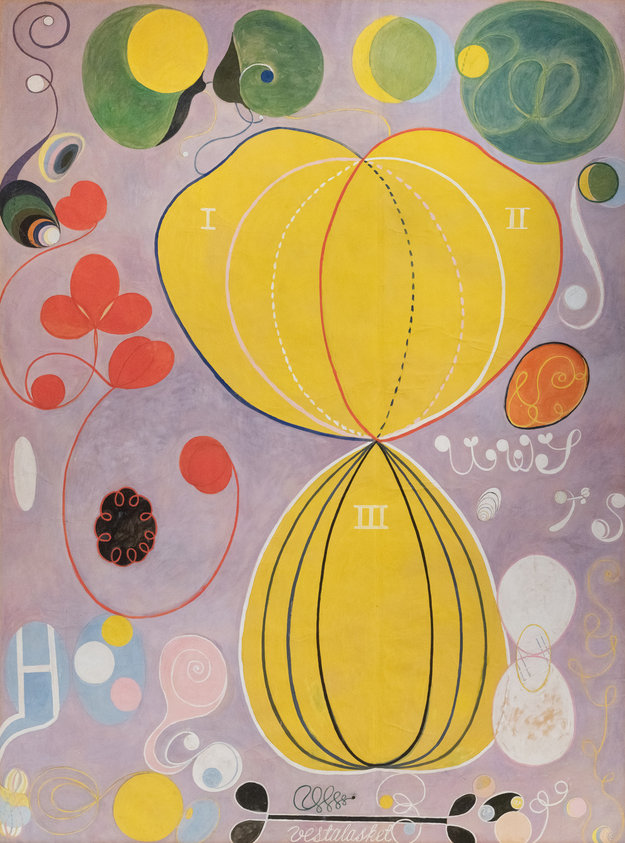
The Ten Largest, No. 7, Adulthood
Hilma af Klint — The Ten Largest — Number 5 Adulthood
Details
- Palette
-
Select a color to find related artworks.
- Origin
- Sweden
- Holding institution
- The Hilma af Klint Foundation
- Image provider
- wikimedia-commons
- License
- Public domain
- Credit
- The Hilma af Klint Foundation
Art Genome Taxonomy
12 tags
Subject Matter
-
Line, Form, and Color Visual · 98%
Lines, contours, numerals, and colored shapes are central to the work’s visual organization, with strong contrasts among yellow, green, red, white, black, blue, orange, and lavender.
-
Text Visual · 98%
Roman numerals I, II, and III and several clearly visible cursive or handwritten-looking marks appear within the composition.
-
Symbolic Composition Interpretive · 78%
The numbered sections, emblem-like forms, and systematic arrangement support an interpretation of the composition as symbolically organized, without establishing a specific meaning for each motif.
Styles and Movements
-
Abstract Art Visual · 99%
The image is non-representational overall, relying on organic shapes, lines, circles, and color relationships rather than a naturalistic scene.
Visual Qualities
-
Biomorphic Visual · 98%
The composition uses rounded, leaf-like, seed-like, lobed, cellular, and spiral forms rather than strictly geometric shapes.
-
Patterns Visual · 94%
Repeated circles, spirals, dots, looping lines, and recurring organic motifs are distributed across the lavender field.
Medium and Techniques
-
Painting Metadata · 99%
The catalog identifies the work as a painting made in tempera on paper mounted on canvas.
-
Tempera Metadata · 99%
The catalog explicitly identifies tempera as the painting medium.
-
Work on Paper Metadata · 99%
The catalog identifies paper as the painted support, mounted on canvas.
Time Periods
-
1900 - 1917 Art Metadata · 99%
The catalog dates the work to 1907, placing it within the 1900–1917 period.
Geographic Regions
-
Scandinavian Art Metadata · 97%
The artist is identified as Swedish and the place of origin as Sweden, supporting the catalog’s Scandinavian regional classification.
Materials
-
Use of Paper Metadata · 99%
The supplied catalog identifies paper as a primary support material.
Source & rights
Gsimonov. Own work