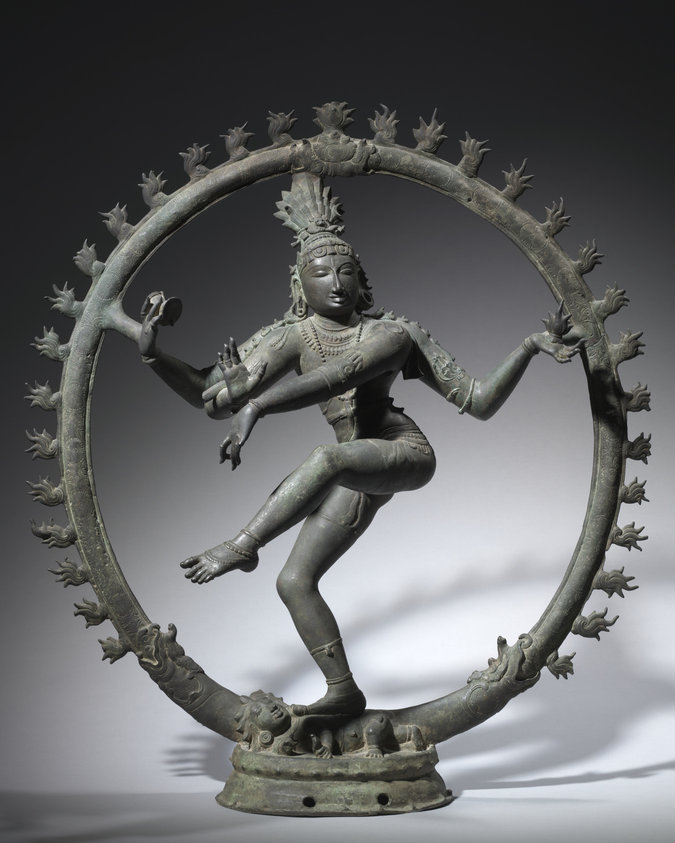
Nataraja, Shiva as the Lord of Dance
One of the most celebrated sculptural forms in the history of Indian art, this elegant and dynamic figure embodies some of Hinduism’s most fundamental tenets. According to Hindu thought, time is cyclical; the world is created, maintained, preserved for a time, then destroyed, only to be created again an infinite number of times. For those Hindus who view Shiva to be the all-powerful creator divinity, he is responsible for both creation and destruction. The ring of fire and the tongue of flame he holds in his left hand refer to destruction, and the drum in his raised right hand refers to the...
Details
- Palette
-
Select a color to find related artworks.
- Medium
- Bronze
- Dimensions
- overall: height 1.13 m, width 1.02 m, depth 0.3 m; base: width 0.35 m, depth 0.24 m
- Department
- Indian and Southeast Asian Art
- Holding institution
- Cleveland Museum of Art
- Image provider
- cleveland-museum-of-art
- License
- CC0-1.0
- Credit
- Purchase from the J. H. Wade Fund
Art Genome Taxonomy
12 tags
Subject Matter
-
Deities and Holy Figures Both · 99%
The title and catalog identify the central figure as Shiva, while the image presents a richly adorned divine figure with multiple arms and characteristic attributes.
-
Mythology and Religion Both · 98%
The catalog explicitly situates the imagery within Hindu thought and identifies Shiva as the subject; the image includes a flame ring, drum, raised palm, raised foot, and a small figure beneath him.
-
Movement Both · 99%
The figure is represented in an expansive dancing pose with bent legs, extended arms, and a raised foot; the title identifies Shiva as the Lord of Dance.
-
Human Figure Visual · 99%
The sculpture presents a fully modeled human-like body with articulated limbs, face, hands, and feet.
Visual Qualities
-
Highly Ornamented Visual · 97%
The figure has an elaborate crown, earrings, layered necklaces, bracelets, anklets, costume details, and a densely decorated flame aureole.
-
Curvilinear Forms Visual · 95%
Sweeping curves organize the aureole, flame projections, limbs, torso, jewelry, and ornamental details.
-
Balance Visual · 92%
The dynamic asymmetry of the dancing figure is contained within a centered pedestal and nearly circular aureole, producing a visually stable composition.
Medium and Techniques
-
Sculpture Both · 99%
The image shows a freestanding, fully modeled three-dimensional figure and circular aureole on a pedestal; the museum classifies the work as sculpture.
Time Periods
-
1000 - 1400 CE Art Metadata · 96%
The museum dates the work to the 1000s, within the catalog period spanning 1000–1400 CE.
Geographic Regions
-
Indian Art Metadata · 99%
The catalog gives the place of origin as South India, Tamil Nadu, during the Chola period.
Materials
-
Bronze Both · 99%
The museum identifies the medium as bronze, and the image shows a dark green-brown metal surface consistent with a bronze sculpture.
Cultural and Religious Styles
-
Hindu Art and Architecture Metadata · 99%
The catalog identifies the work as a Hindu image and places it within the artistic context of South India.
Source & rights
Unknown artist. Nataraja, Shiva as the Lord of Dance. Cleveland Museum of Art.