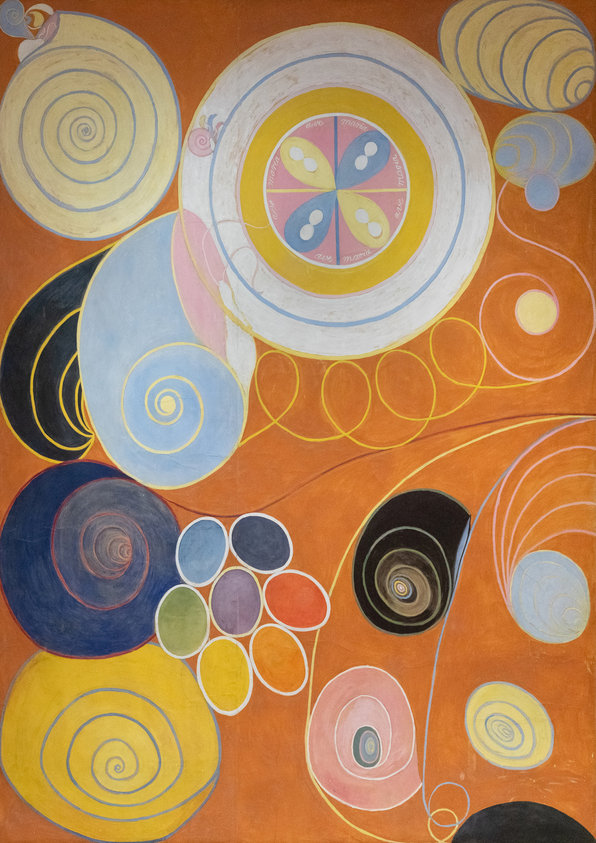
The Ten Largest, No. 3, Youth
Hilma af Klint — The Ten Largest — Number 3 Youth
Details
- Palette
-
Select a color to find related artworks.
- Origin
- Sweden
- Holding institution
- The Hilma af Klint Foundation
- Image provider
- wikimedia-commons
- License
- Public domain
- Credit
- The Hilma af Klint Foundation
Art Genome Taxonomy
11 tags
Subject Matter
-
Line, Form, and Color Visual · 94%
Line, contour, and color function as the primary carriers of structure in an otherwise nonrepresentational composition.
Styles and Movements
-
Abstract Art Visual · 99%
Nonrepresentational circular, spiral, oval, and looping forms dominate the composition rather than recognizable pictorial objects or a conventional scene.
Visual Qualities
-
Curvilinear Forms Visual · 98%
The composition prominently uses circular, oval, spiral, and looping contours throughout the picture plane.
-
Patterns Visual · 94%
Repeated spirals, concentric rings, outlined ovals, and recurring color-and-contour structures create a patterned visual rhythm.
-
Asymmetrical Visual · 95%
The large central structure is offset within an uneven arrangement of forms of varying sizes, producing an asymmetrical overall composition.
-
Bright and Vivid Colors Visual · 90%
The image uses strong contrasts among terracotta orange, yellow, pale blue, pink, green, white, black, and dark blue-purple areas.
Medium and Techniques
-
Painting Both · 99%
The metadata classifies the work as a painting, and the image visibly presents a painted composition on a single vertically oriented support.
-
Tempera Metadata · 99%
The catalog identifies the medium as tempera on paper, mounted on canvas.
-
Work on Paper Metadata · 99%
The catalog identifies paper as the primary support, with the paper mounted on canvas.
Time Periods
-
1900 - 1917 Art Metadata · 99%
The work is dated 1907, which falls within the catalog period 1900–1917.
Geographic Regions
-
Scandinavian Art Metadata · 96%
The catalog gives Sweden as the place of origin, supporting the broader Scandinavian regional category.
Source & rights
Gsimonov. Own work