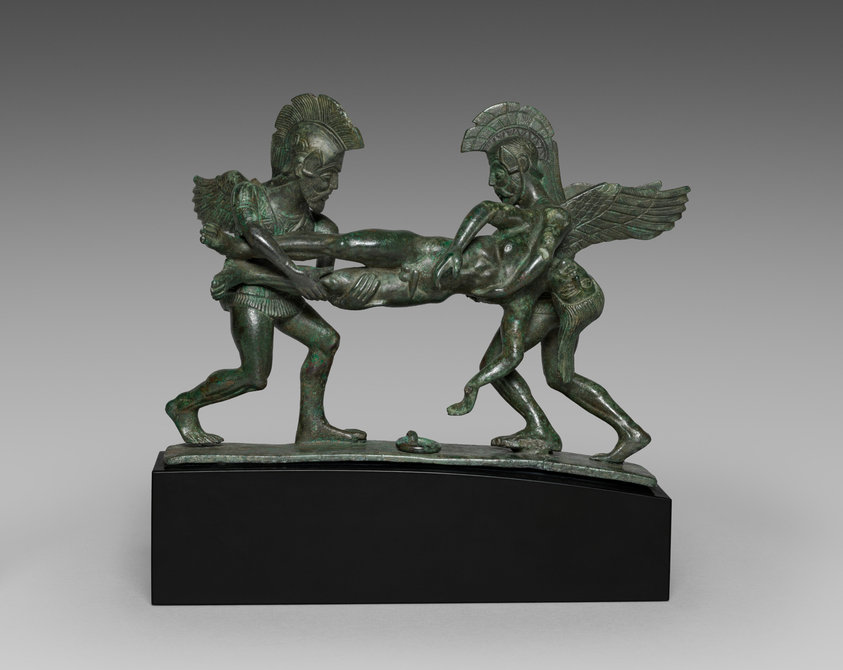
Sleep and Death Cista Handle
Designed for attachment to the lid of a large bronze cista, a cylindrical lidded box, these three figures probably represent Sleep (Hypnos) and Death (Thanatos) holding the body of Sarpedon. A son of Zeus who helped to defend Troy from invading Greek forces, "godlike Sarpedon of the brazen helmet" fell at the hands of Patroclus, as told by Homer in Book XVI of the Iliad. Apollo then intervened to protect the body, removing it from danger and entrusting it to the two winged deities, as depicted here and in a number of other ancient artworks, Greek and Etruscan alike. If not Sarpedon, the fal...
Details
- Palette
-
Select a color to find related artworks.
- Medium
- bronze
- Dimensions
- with base: height 0.185 m, width 0.183 m; without base: height 0.14 m, width 0.174 m
- Origin
- Etruscan
- Department
- Greek and Roman Art
- Holding institution
- Cleveland Museum of Art
- Image provider
- cleveland-museum-of-art
- License
- CC0-1.0
- Credit
- Purchase from the J. H. Wade Fund
Art Genome Taxonomy
11 tags
Subject Matter
-
Classical Mythology Metadata · 98%
The museum description identifies the figures probably as Sleep, Death, and Sarpedon, with Memnon recorded as an alternative for the fallen warrior.
-
Human Figure Visual · 99%
The composition contains three modeled human figures: two standing carriers and a horizontally recumbent body.
-
Implied Narrative Both · 98%
The linked gestures and overlapping bodies depict the carrying of a fallen warrior, making the mythological action legible as an implied narrative.
-
Movement Visual · 97%
Bent knees, extended arms, diagonal limbs, opposing strides, and projecting wings give the group an active sense of physical motion.
Visual Qualities
-
Dynamism Visual · 94%
The counterbalancing poses and strong horizontal and diagonal lines produce an energetic, dynamic composition.
-
Highly Detailed Visual · 89%
At a small scale, the sculpture articulates crested helmets, armor-like garments, feathered wings, hair, facial features, and bodily anatomy.
Medium and Techniques
-
Sculpture Both · 99%
The museum classifies the work as sculpture, and the image shows a three-dimensional figurative group modeled in the round.
Time Periods
-
Ancient Art Metadata · 99%
The work is dated 400–375 BCE, placing it within the ancient Mediterranean world.
Materials
-
Bronze Both · 99%
The catalog identifies the medium as bronze, while the image shows a dark green-brown metallic surface with patination and brighter highlights on raised areas.
Cultural and Religious Styles
-
Etruscan Art Metadata · 99%
The museum records the place of origin as Etruscan.
-
Greek and Roman Art and Architecture Metadata · 86%
The museum classifies the work within Greek and Roman Art, and its subject derives from Greek mythological tradition.
Source & rights
Unknown artist. Sleep and Death Cista Handle. Cleveland Museum of Art.