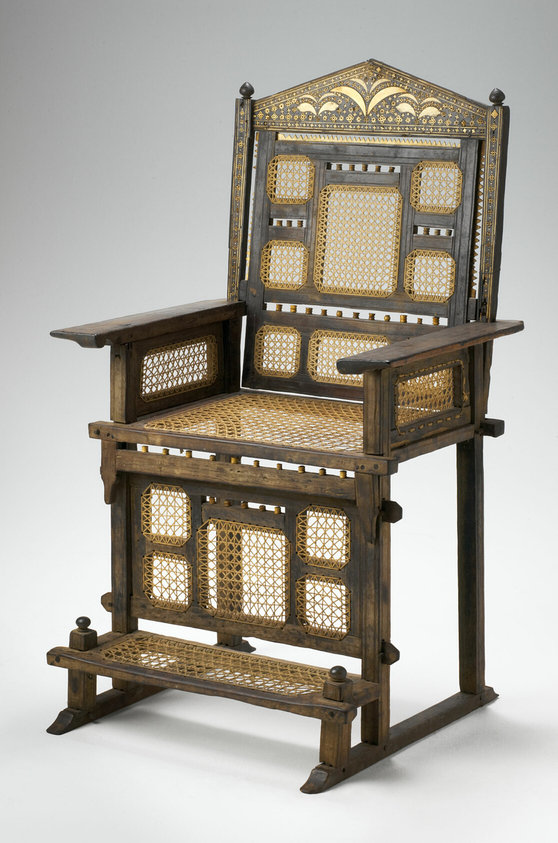
Chair (Kiti Cha Enzi)
This chair illustrates the complex history of trade and conquest in the region known as the Swahili Coast. The region’s natural harbors first invited exchange with partners in the Persian Gulf and Western India. Later, the Portuguese, Omani, and British imposed their authority. Each conquering state brought goods, practices, and other foreign influences, which local artisans artfully synthesized and reshaped in their own chairs.
Details
- Palette
-
Select a color to find related artworks.
- Dimensions
- 125.7 × 75.6 × 72.4 cm (49 1/2 × 29 3/4 × 28 1/2 in.)
- Origin
- Kenya
- Department
- Arts of Africa
- Holding institution
- Art Institute of Chicago
- Image provider
- art-institute-chicago
- License
- CC0-1.0
- Credit
- Purchased with funds provided by Marshall Field V
Art Genome Taxonomy
12 tags
Visual Qualities
-
Patterns Both · 98%
The image shows repeated lattice, floral, geometric, and border ornament, while the catalog identifies a plant-derived motif.
-
Symmetrical Visual · 97%
The high back and ornament are organized around a strong central axis with paired panels, borders, arm structures, and supports.
-
Geometric Visual · 96%
Rectangular panels, diamond latticework, triangular borders, and repeated circular and polygonal details dominate the design.
-
Highly Ornamented Visual · 98%
The crest, uprights, back panels, arms, seat, and lower supports are extensively decorated with openwork, inlay, turned elements, finials, and patterned borders.
-
Woven/Perforated Visual · 96%
Open latticework visibly perforates the back, seat, arm panels, and lower front structure.
Time Periods
-
19th Century Art Metadata · 99%
The catalog dates the chair to the 19th century, with a date range of 1801–1900.
Geographic Regions
-
East African Art Metadata · 99%
The work is identified as Swahili, made in Lamu, Kenya, and associated with the Eastern and Southern Africa region.
Materials
-
Wood Metadata · 99%
Wood is explicitly listed in the museum medium and forms the visible structural frame.
-
Ivory Metadata · 95%
Ivory is explicitly listed in the museum medium and the catalog description identifies ivory inlay, although the image cannot distinguish ivory from bone.
-
Natural Fibers Metadata · 80%
Cotton fiber is explicitly listed in the museum medium, though its specific location is not distinguishable with certainty in the image.
Design Concepts and Techniques
-
Handcrafted Furniture and Design Both · 86%
The individually articulated wooden members, openwork panels, inlay, turned elements, and extensive ornament indicate labor-intensive craft production; the catalog describes local artisans and specialized workshops.
Furniture and Lighting
-
Chair Both · 99%
The catalog classifies the object as a chair, and the image clearly shows a high-backed seat with armrests, an openwork seat, and supporting legs.
Source & rights
Swahili. Chair (Kiti Cha Enzi). The Art Institute of Chicago.