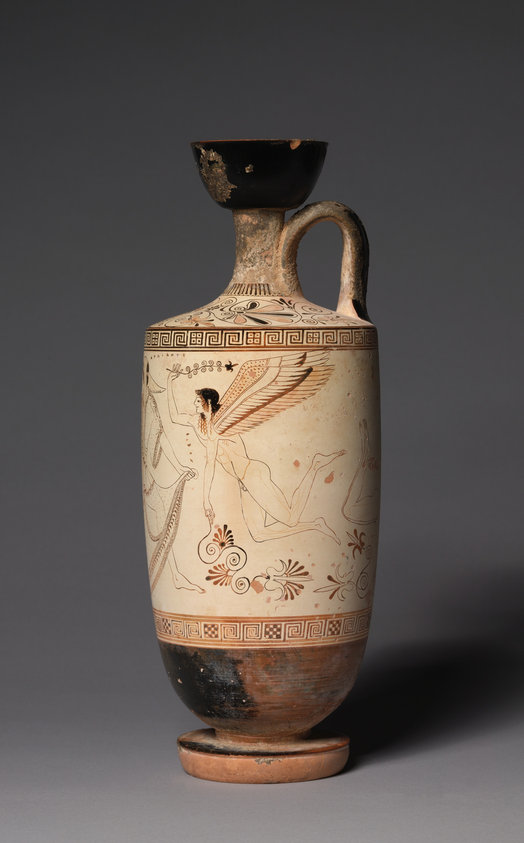
White-Ground Lekythos (Oil Vessel): Atalanta and Erotes
Douris (attributed)
Known as "white-ground" because of the white clay slip applied as a surface for figural decoration, vases of this type give some idea of the appearance of lost ancient large-scale wall paintings. Both remarkably well preserved and masterfully composed, the images cover the entire circumference of the vase. At the center, Atalanta, the virgin huntress renowned for both her speed and her opposition to marriage, races to the right while looking back at Eros, the winged god of love; both figures are named. This Eros, bounding forward, tries to crown her, while two additional Erotes (also named)...
Details
- Palette
-
Select a color to find related artworks.
- Medium
- ceramic
- Dimensions
- overall: height 0.318 m
- Origin
- Greek, Attic
- Department
- Greek and Roman Art
- Holding institution
- Cleveland Museum of Art
- Image provider
- cleveland-museum-of-art
- License
- CC0-1.0
- Credit
- Leonard C. Hanna Jr. Fund
Art Genome Taxonomy
10 tags
Subject Matter
-
Classical Mythology Metadata · 99%
The catalog identifies the figures as Atalanta, Eros, and additional Erotes in a mythological scene.
-
Movement Both · 95%
The visible figures are rendered in running and bounding poses, while the catalog describes Atalanta racing and Eros pursuing her.
-
Love Metadata · 96%
The catalog identifies Eros as the winged god of love and describes his attempt to crown Atalanta.
-
Human Figure Visual · 98%
Several outlined human figures occupy the principal decorative field of the vessel.
Visual Qualities
-
Patterns Visual · 98%
Repeated meander bands, spiral scrolls, palmette-like forms, and floral ornaments organize the shoulder and borders.
-
Linear Forms Visual · 96%
The figural decoration relies on fine contour lines, especially in the bodies, wings, garments, and ornamental scrollwork.
Time Periods
-
Ancient Art Metadata · 99%
The catalog dates the vessel to approximately 500–490 BCE.
Materials
-
Ceramic Both · 99%
The object is visibly a fired ceramic vessel, and the catalog classifies its medium as ceramic.
Cultural and Religious Styles
-
Greek and Roman Art and Architecture Metadata · 98%
The catalog identifies the place of origin as Greek, Attic, and the work belongs to the museum’s Greek and Roman Art collection.
Tableware, Vessels, and Objects
-
Vessel Both · 99%
The image shows a handled, footed vessel, and the catalog identifies it as a lekythos, or oil vessel.
Source & rights
Douris (Greek, Attic, active c. 500–470 BCE). White-Ground Lekythos (Oil Vessel): Atalanta and Erotes. Cleveland Museum of Art.