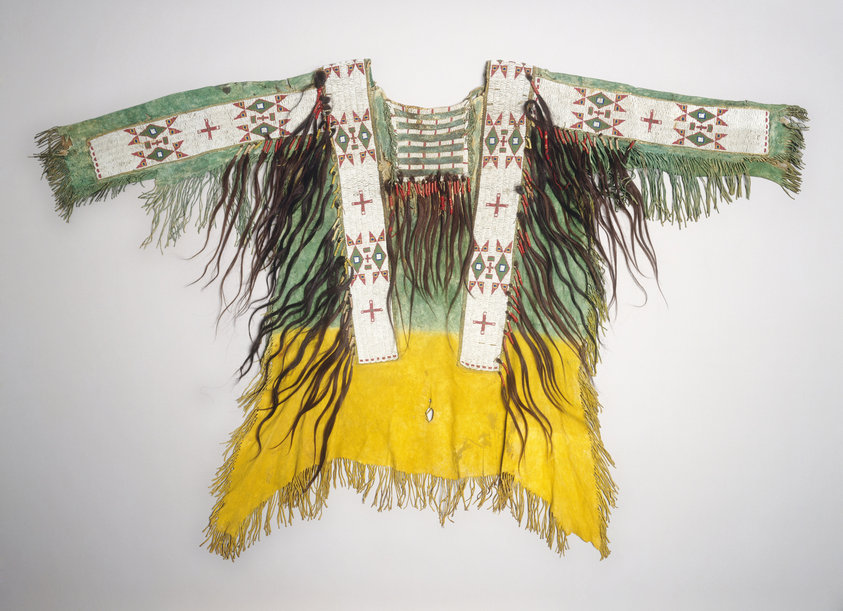
Hide Shirt
Traditionally, only Lakota (Sioux) head chiefs had the right to wear painted shirts, an honor they earned through sacrifice and bravery but lost by failing in their responsibilities. By the time this example was created, European Americans had confined the Lakota to reservations, and painted shirts had become the privilege of battle veterans rather than of active warriors. Family members probably donated the locks of hair, each representing a war exploit.
Details
- Palette
-
Select a color to find related artworks.
- Dimensions
- overall: height 0.978 m, width 1.5 m
- Department
- Textiles
- Holding institution
- Cleveland Museum of Art
- Image provider
- cleveland-museum-of-art
- License
- CC0-1.0
- Credit
- Bequest of David S. McMillan
Art Genome Taxonomy
10 tags
Visual Qualities
-
Patterns Visual · 99%
Repeated beadwork motifs, horizontal bands, crosses, and multicolored geometric forms organize the sleeves, shoulder area, and central front panels.
-
Geometric Visual · 98%
The ornament consists of angular diamonds, triangles, crosses, stripes, and rectilinear arrangements.
-
Symmetrical Visual · 95%
The displayed garment has a strong left-right balance, with corresponding sleeves, vertical front panels, painted areas, and hanging attachments.
-
Highly Ornamented Both · 98%
The catalog records pigment, beads, and human hair, while the image shows extensive beadwork, painted surfaces, fringe, and numerous hair locks across the garment.
-
Bright and Vivid Colors Visual · 95%
The painted green and yellow hide, white beadwork, and red, blue, and black details produce a clearly vivid multicolor surface.
Time Periods
-
19th Century Art Metadata · 99%
The catalog dates the shirt to approximately 1890, within the nineteenth century.
Materials
-
Leather/Hide Metadata · 99%
Hide is explicitly listed in the museum's medium field and forms the shirt's underlying material.
-
Glass as Material Metadata · 97%
Glass beads are explicitly listed in the medium field and are visibly used in the white beaded bands and geometric ornament.
Cultural and Religious Styles
-
Native American, First Nations, and Alaska Native Art Metadata · 99%
The catalog identifies the object as Lakota Sioux and Native North American, from the Central Plains.
Textiles
-
Textile Arts Metadata · 99%
The museum classifies the object as a textile and places it in the Textiles department.
Source & rights
Unknown artist. Hide Shirt. Cleveland Museum of Art.