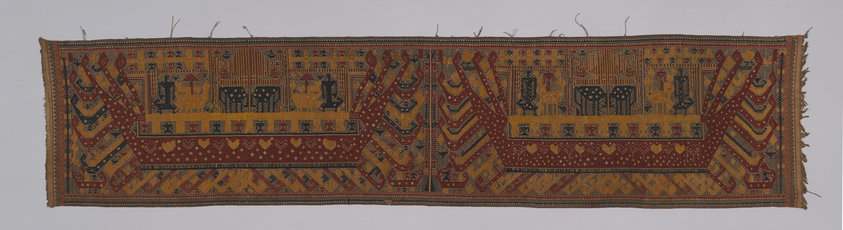
Ceremonial Hanging (Palepai)
The Paminggir aristocracy employed a type of ritual hanging commonly known as a ship cloth, a name that refers to one of the principal motifs of such textiles. These hangings display a very limited repertoire of patterns, including one or two red ships, a single blue ship, tree images, buildings, and rows of stylized anthropomorphic figures. The indigenous name for textiles of this type, palepai, probably goes back to the old Javanese word lepih, which means “to fold” or “to double.” Palepai served as markers of status and perhaps even denoted descent. Indeed, title, claim to leadership, an...
Details
- Palette
-
Select a color to find related artworks.
- Dimensions
- Without fringe: 67 × 296.6 cm (26 3/8 × 116 3/4 in.)
- Origin
- Indonesia
- Department
- Textiles
- Holding institution
- Art Institute of Chicago
- Image provider
- art-institute-chicago
- License
- CC0-1.0
- Credit
- Gift of E. M. Bakwin Indonesian Textile Collection
Art Genome Taxonomy
12 tags
Subject Matter
-
Nautical Both · 99%
Two prominent ship motifs are visible, and the catalog lists boats and seas among the subjects of the hanging.
-
Human Figure Both · 82%
Small stylized anthropomorphic forms appear in repeated registers, and the catalog explicitly identifies figures as one of the textile’s subjects.
Visual Qualities
-
Dense Composition Visual · 98%
The elongated field is densely filled with ships, repeated motifs, figures, architectural forms, and multiple borders, leaving little unpatterned ground.
-
Patterns Visual · 99%
The surface is organized through extensive repetition of geometric, linear, figurative, and wave-like motifs.
-
Geometric Visual · 95%
The ships and surrounding ornament use strongly angular, stepped, rectilinear, and repeated forms.
-
Symmetrical Visual · 88%
Two large ship motifs balance one another on either side of a narrow central vertical zone, producing an overall near-symmetrical arrangement.
Time Periods
-
19th Century Art Metadata · 99%
The catalog dates the object to the 19th century, with date bounds of 1801–1900.
Geographic Regions
-
Southeast Asian Art Metadata · 98%
The catalog identifies the place of origin as Indonesia and the makers as the Paminggir people of South Sumatra.
Textiles
-
Tapestry and Wall Hanging Metadata · 99%
The catalog identifies the object as a ceremonial or ritual hanging textile.
-
Textile Arts Both · 99%
The work is cataloged as a woven textile with supplementary patterning and brocading, and the image clearly shows a large patterned textile hanging.
-
Use of Fabric Both · 98%
The catalog specifies cotton and silk among the materials, while the image visibly presents a fabric surface with woven edges and fringe.
Antiquities, Artifacts, and Religious Objects
-
Ceremonial Object Metadata · 97%
The catalog classifies the work as a religious/ritual object and describes its use in rites of passage.
Source & rights
Paminggir. Ceremonial Hanging (Palepai). The Art Institute of Chicago.