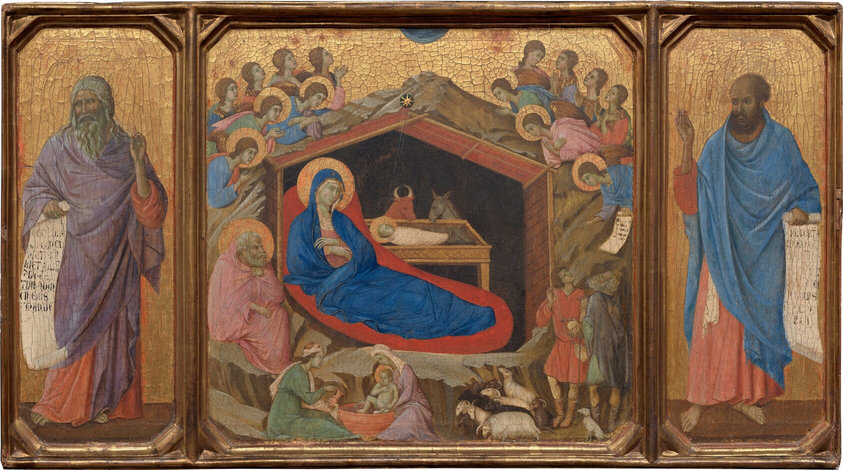
The Nativity with the Prophets Isaiah and Ezekiel
This horizontal painting is made up of three parts: in the center square panel, a woman reclines under a wooden shelter set into a rocky cave, which is surrounded by angels, and narrower wings to either side are each occupied by a standing man. All the people have pale skin, which is tinged with faint green. The three panels are joined with a gold frame, and the gold background behind the central scene and the men in the side panels are covered with a noticeable network of cracks. In the central panel, a cobalt-blue robe nearly envelopes the reclining woman’s body; this is Mary. It covers her head and falls open where she crosses her wrists over her chest to show a pink garment underneath. A flat gold halo encircles her head ,and her body is surrounded by a field of crimson red, almost like an aura. She rests under a wooden structure with a pitched roof, which is surrounded by craggy, barren rock. A swaddled infant lies in a rectangular, tray-like manger. The infant’s head is also surrounded by a gold halo. Fine gold rays emanate down into the structure from a star just above the peak of the roof. A bull and a donkey look down at the baby from the far side of the manger. The interior of the structure behind them is black. In a smaller scale, two women wash a haloed infant in a tub in front of the rocky cave near the lower left corner of this panel. A man with a white beard and hair sits to our left of Mary, holding a pink cloak at his throat and looking toward the infant. Above and around the rocks, seven winged and haloed angels cluster on each side. One angel to the right presents a scroll with black writing to two men accompanied by a dog and several sheep in the lower right. The man in the panel to the left, Isaiah, has a gray beard and long, wavy hair, and he wears a lilac-purple cloak draped over a coral-orange robe. In his right hand, on our left, he holds an unfurled scroll with large black lettering. His other hand is raised with one finger pointing upward. He looks to our left, away from the central scene. On the right, Ezekiel, echoes Isaiah's pose. Ezekiel holds an open scroll with his left hand, on our right, and his other hand is raised. He also wears a coral-colored robe, but his is overlaid with a blue cloak. His receding hair is short and brown, as is his beard. Like Isaiah, he takes up most of the height of the panel and gazes to our left, toward the central panel.
Details
- Palette
-
Select a color to find related artworks.
- Dimensions
- painted surface (left side image): 43 × 16 cm (16 15/16 × 6 5/16 in.) painted surface (center image): 43 × 43.9 cm (16 15/16 × 17 5/16 in.) painted surface (right side image): 43 × 16 cm (16 15/16 × 6 5/16 in.) overall (including original frame): 48 × 86.8 × 7.9 cm (18 7/8 × 34 3/16 × 3 1/8 in.) framed: 56.52 × 96.52 × 15.24 cm (22 1/4 × 38 × 6 in.)
- Department
- CIS-R
- Holding institution
- National Gallery of Art
- Image provider
- national-gallery-of-art
- License
- CC0-1.0
- Credit
- Andrew W. Mellon Collection
Art Genome Taxonomy
12 tags
Subject Matter
-
Bible Story Both · 99%
The catalog title identifies the subject as a Nativity, and the central panel visibly depicts Mary, the infant Christ, angels, animals, shepherds, and the shelter.
-
Madonna and Child Both · 99%
Mary is visibly reclining beside the swaddled infant Christ in the central panel, consistent with the catalog’s identification of the scene.
-
Deities and Holy Figures Both · 99%
The catalog identifies the flanking figures as the prophets Isaiah and Ezekiel; the image shows them as monumental haloed figures holding inscribed scrolls, along with other sacred figures in the central scene.
-
Animals Visual · 99%
The central panel visibly includes an ox, donkey, sheep, and dog, as well as additional animals near the foreground and shelter.
-
Text Both · 99%
Black writing is visibly present on the scrolls held by the two prophets and by a figure in the central scene; the catalog description also confirms writing on the scrolls.
Styles and Movements
-
Medieval Art Both · 98%
The 1308–1311 date and the image’s gold-ground panel format, halos, elongated figures, and hierarchical sacred arrangement support a medieval artistic context.
Visual Qualities
-
Cracked Visual · 99%
A pronounced network of fine cracks is visible across the gold-colored grounds, halos, and much of the painted surface, especially in the side panels and upper central field.
-
Highly Ornamented Visual · 92%
Gold-colored grounds, patterned halos, elaborate drapery, decorative framing, and numerous carefully rendered figures give the image a richly ornamented appearance.
Medium and Techniques
-
Painting Both · 99%
The National Gallery of Art classifies the work as a painting in tempera on a single poplar panel, and the image clearly presents a painted three-panel composition.
Time Periods
-
1000 - 1400 CE Art Metadata · 99%
The catalog date of 1308–1311 falls within the catalog’s 1000–1400 CE period.
Materials
-
Wood Metadata · 99%
The catalog specifies tempera on a single poplar panel, supporting wood as the panel material.
Cultural and Religious Styles
-
Christian Art and Architecture Both · 98%
The Nativity subject, prophets, halos, angels, and devotional panel format establish a Christian religious context visible in the image and confirmed by the catalog title.
Source & rights
Duccio di Buoninsegna. The Nativity with the Prophets Isaiah and Ezekiel. Courtesy National Gallery of Art, Washington.