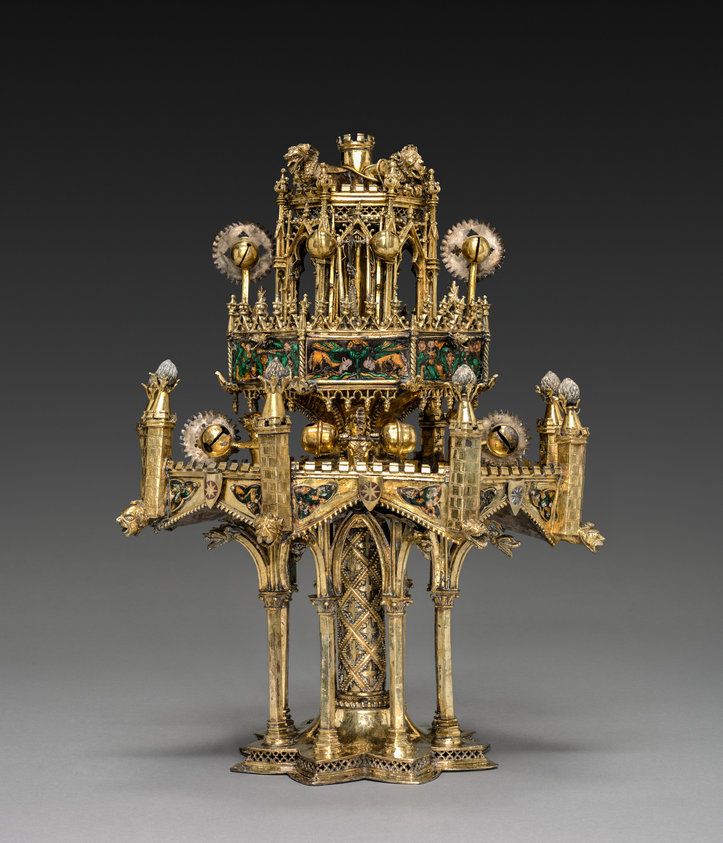
Table Fountain
Conceptually and stylistically, this object is beyond all else a piece of Gothic architecture in miniature with vaults, pinnacles, columns, and traceried arches. Though the artist who created it is unknown, he was unquestionably inspired by the great Gothic buildings of his time. The table fountain is a three-tiered assembly combining cast elements with bent sheets of gilt-silver. To these have been attached a series of enamel plaques representing grotesque figures, some of which play musical instruments. Water wheels and bells were added to capture motion and sound. The rich detail, precio...
Details
- Palette
-
Select a color to find related artworks.
- Dimensions
- overall: height 0.311 m, width 0.241 m, depth 0.26 m; No Extent Specified: width 0.022 m
- Origin
- France, Paris
- Department
- Medieval Art
- Holding institution
- Cleveland Museum of Art
- Image provider
- cleveland-museum-of-art
- License
- CC0-1.0
- Credit
- Gift of J. H. Wade
Art Genome Taxonomy
10 tags
Artistic Disciplines
-
Architecture Both · 98%
The object visibly takes the form of a freestanding architectural structure with columns, arcades, pointed arches, pinnacles, vault-like elements, and traceried openings; the museum describes it as Gothic architecture in miniature.
Styles and Movements
-
Medieval Art Metadata · 99%
The Cleveland Museum of Art classifies the object as Medieval Art and dates it to approximately 1320–1340.
-
Gothic Art Both · 98%
Pointed arches, slender supports, pinnacles, tracery, and pronounced verticality are visible in the image, while the museum identifies the object as inspired by Gothic buildings.
Visual Qualities
-
Highly Ornamented Both · 99%
The surface is densely enriched with architectural moldings, openwork, pinnacles, small figures, animals, plaques, wheel-like elements, and other projecting details; the catalog emphasizes the object's involved ornamentation.
-
Symmetrical Visual · 94%
The frontal view reveals a strong central axis and broadly bilateral arrangement, with paired columns, arcades, wheel-like forms, and side structures.
Time Periods
-
1000 - 1400 CE Art Metadata · 99%
The catalog date, c. 1320–40, falls within the 1000–1400 CE period.
Geographic Regions
-
French Art Metadata · 97%
The catalog gives the place of origin as Paris, France.
Materials
-
Silver Metadata · 99%
The stated medium is gilt-silver and translucent enamels; silver is the principal underlying metal identified by the catalog.
-
Gold Metadata · 93%
The term gilt-silver indicates a gold-coated surface, consistent with the visibly gilded appearance.
-
Enamel Both · 99%
Colored enamel plaques are clearly visible within the architectural framework, and the catalog identifies translucent enamels as part of the medium.
Source & rights
Unknown artist. Table Fountain. Cleveland Museum of Art.