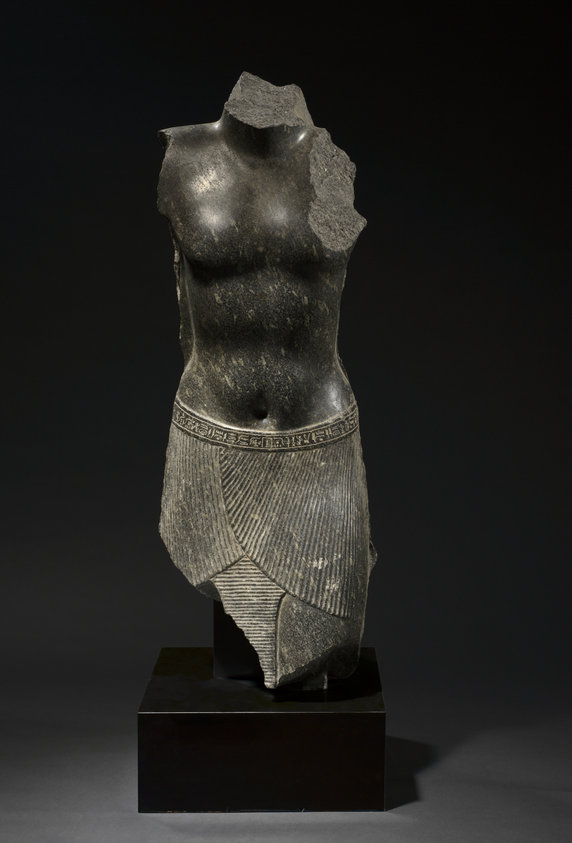
Torso of Amenpayom
This magnificent life-sized torso is inscribed for Amenpayom, the great army general of the district of Mendes in the Nile Delta. By the end of the Ptolemaic dynasty (305-30 BC) when this statue was made, the Egyptians could draw on 3,000 years of expertise carving hard stone. Enough remains to show that Amenpayom was represented in the traditional pose for men: left leg striding forward, arms at his sides, and supported by a back pillar. The subtle, masterful treatment of the undulating musculature and meticulous, flawless polish are hallmarks of this period, when Egyptian artists reveled ...
Details
- Palette
-
Select a color to find related artworks.
- Medium
- granodiorite
- Dimensions
- overall: height 0.964 m, width 0.323 m, depth 0.286 m
- Department
- Egyptian and Ancient Near Eastern Art
- Holding institution
- Cleveland Museum of Art
- Image provider
- cleveland-museum-of-art
- License
- CC0-1.0
- Credit
- Gift of the Hanna Fund
Art Genome Taxonomy
11 tags
Subject Matter
-
Human Figure Both · 99%
The surviving work clearly represents a human torso and partial lower body; the catalog identifies it as the torso of Amenpayom.
-
Portrait Metadata · 76%
The work is inscribed for Amenpayom, a named individual identified by the museum as the great army general of the district of Mendes. The missing head prevents assessment of facial likeness.
-
Text Visual · 94%
Incised signs are visibly carved in a narrow band encircling the waist, although the inscription is not legible in the image.
Visual Qualities
-
Smooth Surface Both · 94%
Broad areas of the chest, abdomen, and waist show a smooth, reflective polish, while broken edges remain rough and granular.
-
Highly Detailed Visual · 91%
The wrapped garment contains numerous closely spaced diagonal and vertical incised lines, and the waist band carries additional carved detail.
Medium and Techniques
Time Periods
-
Ancient Art Metadata · 96%
The museum dates the sculpture to probably 200–100 BCE.
Geographic Regions
-
Egyptian Art Metadata · 99%
The catalog gives Egypt, the Greco-Roman period, and the Ptolemaic dynasty as the work's place and historical context.
Materials
-
Stone Metadata · 99%
The museum identifies the medium as granodiorite, a type of stone.
Cultural and Religious Styles
-
Ancient Egypt Metadata · 93%
The work is identified as Ptolemaic Egyptian art and was made within the ancient Egyptian cultural tradition.
Source & rights
Unknown artist. Torso of Amenpayom. Cleveland Museum of Art.