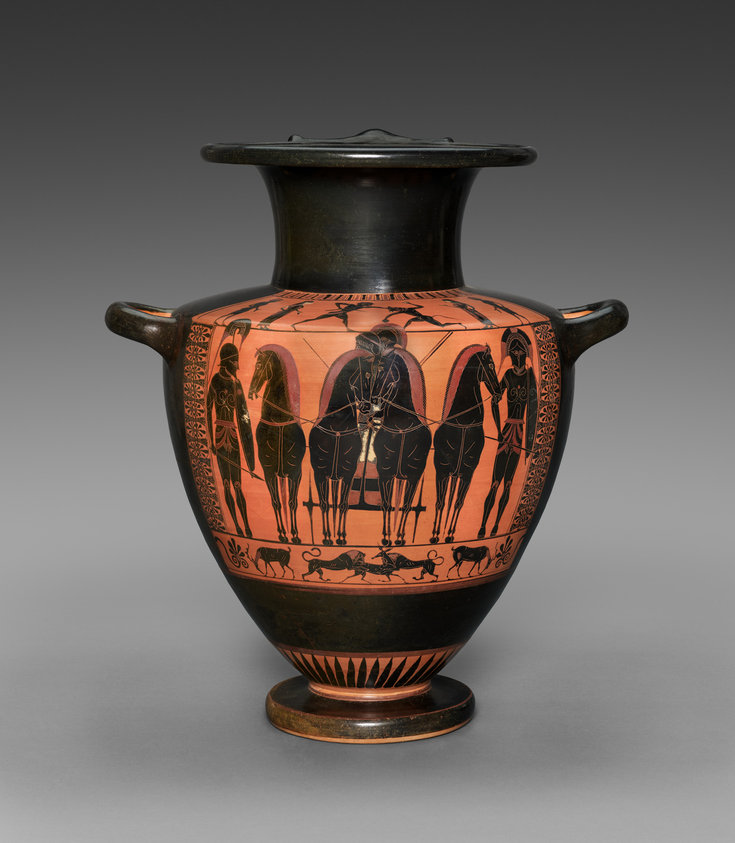
Black-Figure Hydria (Water Vessel): Frontal Quadriga (Body); Theseus and Minotaur (Shoulder)
Antimenes Painter (attributed)
Although their subjects differ, the three fields of figured decoration on this vessel relate to one another metaphorically through the theme of victory. Just as Theseus defeats the Minotaur on the shoulder, two lions converge on a deer in the predella (the small, lowermost panel). In the largest panel, victory is still to come, presumably for all three warriors shown: one in the chariot behind his driver, and one on foot on either side. Somewhat unusually, two of the warriors look directly out at the viewer, their frontal faces an interesting complement to the much more common frontal chariot.
Details
- Palette
-
Select a color to find related artworks.
- Medium
- ceramic
- Dimensions
- overall: height 0.432 m; diameter of rim: width 0.247 m; diameter of foot: width 0.152 m
- Origin
- Greece, Attic
- Department
- Greek and Roman Art
- Holding institution
- Cleveland Museum of Art
- Image provider
- cleveland-museum-of-art
- License
- CC0-1.0
- Credit
- Purchase from the J. H. Wade Fund
Art Genome Taxonomy
8 tags
Subject Matter
-
Animals Both · 99%
The visible lower frieze includes animals, and the catalog identifies two lions converging on a deer.
-
Classical Mythology Both · 99%
The catalog title identifies the shoulder scene as Theseus and the Minotaur, while the image shows a human-versus-monster combat scene.
-
Human Figure Both · 98%
Multiple human figures are visible in the quadriga and warrior scenes; the catalog identifies male figures as a subject.
Visual Qualities
-
Patterns Visual · 94%
Repeated floral borders, radiating bands, geometric borders, and recurring animal and figure motifs create a patterned decorative structure.
Time Periods
-
Ancient Art Metadata · 99%
The vessel is dated to approximately 520 BCE, placing it within ancient art.
Materials
-
Ceramic Metadata · 99%
The catalog lists the classification and medium as ceramic.
Cultural and Religious Styles
-
Greek and Roman Art and Architecture Metadata · 99%
The catalog identifies the object as Attic Greek and places it within the museum's Greek and Roman Art classification.
Tableware, Vessels, and Objects
-
Vessel Metadata · 99%
The museum classifies the object as a hydria, or water vessel; the image clearly shows its broad body, neck, rim, handles, and foot.
Source & rights
Antimenes Painter (Greek, Attic, active c. 530–510 BCE). Black-Figure Hydria (Water Vessel): Frontal Quadriga (Body); Theseus and Minotaur (Shoulder). Cleveland Museum of Art.