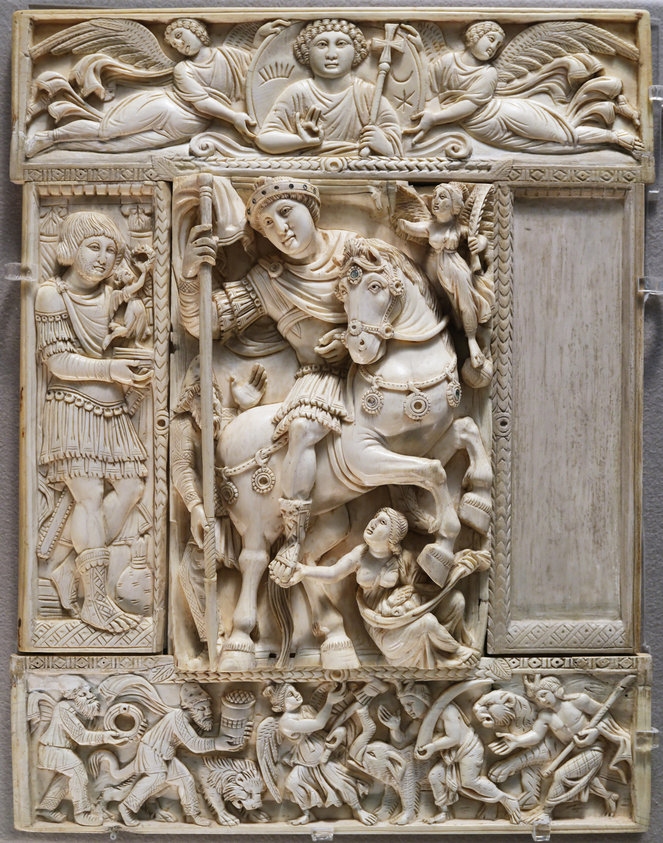
Feuillet de diptyque en cinq parties : l'Empereur triomphant (Justinien ?)
Cet ivoire est le seul feuillet quasi complet de diptyque impérial subsistant de nos jours ; les feuillets étaient constitués d'un assemblage de cinq éléments. Seule manque aujourd'hui la plaquette de droite qui s'emboîtait, comme les autres, autour de la plaque centrale grâce à un système de rainures et d'onglets permettant la largeur importante de l'ensemble. Au centre du diptyque est sculpté en haut-relief le triomphe d'un empereur à cheval, Anastase (491-518) ou plutôt Justinien (527-565). À sa droite, aujourd'hui disparue, une allégorie de la Victoire, posée sur un globe gravé d'une cr...
Details
- Palette
-
Select a color to find related artworks.
- Dimensions
- Hauteur 34,2 cm; Hauteur 19 cm; Largeur 26,8 cm; Largeur 12,5 cm; Epaisseur 2,8 cm
- Origin
- Constantinople (Byzance)
- Holding institution
- Musée du Louvre
- Image provider
- wikimedia-commons
- License
- CC0
- Credit
- Musée du Louvre, Département des Antiquités grecques, étrusques et romaines
Art Genome Taxonomy
12 tags
Subject Matter
-
Equestrian Both · 99%
A mounted imperial figure and a richly harnessed horse occupy the central compartment; the catalog identifies the scene as the triumph of an emperor on horseback.
-
War and Military Both · 95%
The composition includes a military attendant, a lance, a defeated enemy, and populations presenting tribute, all described in the catalog and visible in the relief.
-
Deities and Holy Figures Both · 96%
The upper register contains a frontal sacred figure holding a cross-like attribute and making a blessing gesture; the catalog identifies this figure as Christ.
-
Allegory Metadata · 90%
The catalog identifies the winged Victory and the female figure beneath the horse as allegorical or personified figures, including the symbol of Earth.
Styles and Movements
-
Figurative Sculpture Visual · 98%
The image is dominated by modeled human and animal figures carved in projecting relief, including a mounted ruler, attendants, winged figures, and defeated peoples.
Visual Qualities
-
Highly Detailed Visual · 99%
Fine carved and incised details articulate hair, drapery, armor, horse tack, feathers, foliage, and ornamental borders throughout the relief.
Medium and Techniques
-
Relief Both · 99%
The catalog explicitly describes the central scene as haut-relief, and the image shows figures projecting from a shallow carved ground.
-
Carving Both · 99%
The museum identifies the object as carved elephant ivory, while the image clearly shows extensive three-dimensional carving and incised detail.
Time Periods
-
500 - 1000 CE Art Metadata · 99%
The catalog dates the object to 525–550 CE.
Geographic Regions
-
Eastern Mediterranean Metadata · 90%
The catalog identifies Constantinople, or Byzantium, as the place of origin.
Materials
-
Ivory Metadata · 100%
The catalog specifies elephant ivory as the material.
Cultural and Religious Styles
-
Byzantine Art Metadata · 99%
The museum dates the object to the Byzantine period and identifies Constantinople as its place of origin.
Source & rights
Shonagon. Own work