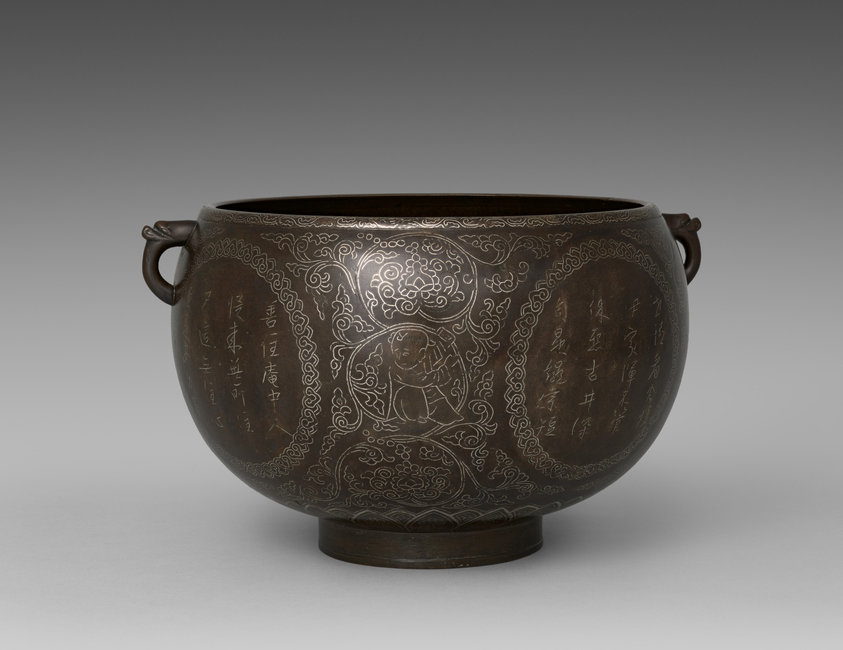
Basin with Inscribed Figures and Calligraphy
This bronze basin may have been used for containing purified water. What makes this work charming is its intricate decoration done in silver inlay: the five-character, four-line poems interspersed among images of a child. The poems, which evoke the concept of nonattachment and nonduality, were written by Buddhist monks.
Details
- Palette
-
Select a color to find related artworks.
- Medium
- bronze
- Dimensions
- overall: height 0.17 m; diameter of mouth with rim: width 0.217 m; height with stand: height 0.017 m; diameter of base: width 0.111 m
- Department
- Korean Art
- Holding institution
- Cleveland Museum of Art
- Image provider
- cleveland-museum-of-art
- License
- CC0-1.0
- Credit
- Leonard C. Hanna Jr. Fund
Art Genome Taxonomy
8 tags
Subject Matter
-
Text Both · 99%
Multiple vertical columns of writing are clearly visible, and the museum identifies them as five-character, four-line poems.
-
Related to Religion Metadata · 93%
The museum states that the poems were written by Buddhist monks and evoke nonattachment and nonduality, establishing a relationship to religious thought.
Visual Qualities
-
Calligraphic Visual · 95%
The surface decoration includes repeated, finely executed linear inscriptions and ornamental scrolling forms with a calligraphic appearance.
Time Periods
-
1000 - 1400 CE Art Metadata · 99%
The museum dates the basin to the 1100s–1200s, within the 1000–1400 CE period.
Geographic Regions
-
Asian Art Metadata · 99%
The object originated in Korea and is classified by the museum under Korean Art; the catalog provides Asian Art as the applicable regional category.
Materials
Tableware, Vessels, and Objects
-
Vessel Both · 99%
The image clearly shows an open basin or bowl-like container with a foot and side handles, and the museum titles it a basin.
Source & rights
Unknown artist. Basin with Inscribed Figures and Calligraphy. Cleveland Museum of Art.