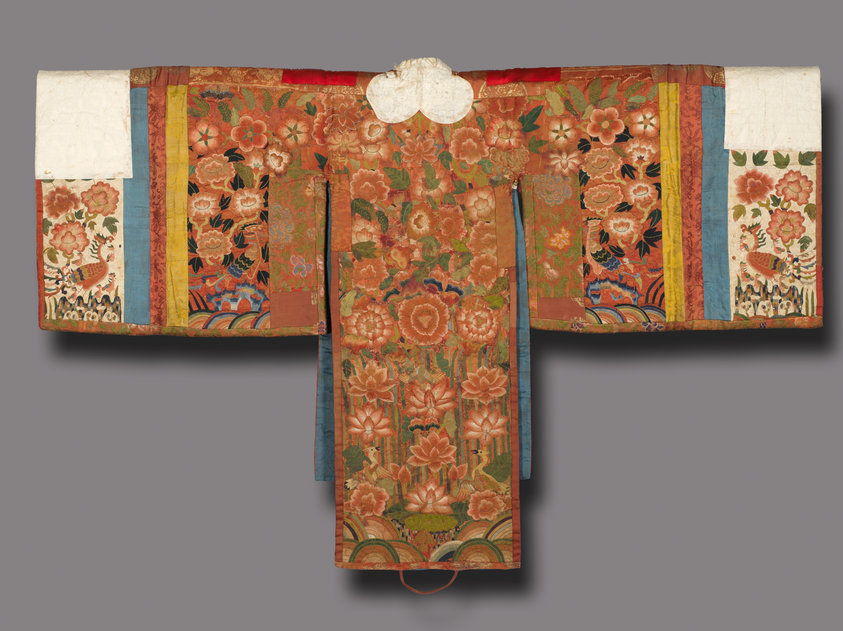
Bridal Robe (Hwarot)
This bride's robe is exquisitely embroidered with various symbols of happiness in colorful silk threads. Butterflies stand for marital happiness; the phoenix, numerous offspring; and lotus flowers and white cranes, longevity. Yet, the bridal robe does not attest to the life of luxury. To the contrary, many traces of repairs, trimmings, and patchwork reflect Joseon period women’s commitment to value neo-Confucian aesthetics of frugality and modesty. Substantial repairs and patching reveal that this robe served as an important communal resource to be shared and passed down through several gen...
Details
- Palette
-
Select a color to find related artworks.
- Dimensions
- overall: height 1.219 m, width 1.867 m
- Department
- Textiles
- Holding institution
- Cleveland Museum of Art
- Image provider
- cleveland-museum-of-art
- License
- CC0-1.0
- Credit
- The Worcester R. Warner Collection
Art Genome Taxonomy
11 tags
Artistic Disciplines
-
Fashion Design and Wearable Art Both · 99%
The catalog identifies the object as a garment and bridal robe; the image shows a T-shaped ceremonial robe with a long central body and broad sleeves.
Subject Matter
-
Flora Both · 98%
Flowers and leaves are prominent throughout the robe, and the museum specifically identifies lotus flowers among its motifs.
-
Animals Both · 95%
Bird forms are visible on the lower sleeve panels and central body; the catalog identifies butterflies, a phoenix, and white cranes among the embroidered motifs.
Visual Qualities
-
Highly Ornamented Visual · 99%
The visible surface is densely covered with multicolored floral, foliage, bird, and wave-like ornament, leaving little undecorated ground.
-
Patterns Visual · 98%
Repeated blossoms, leaves, framed panels, vertical borders, and curved wave-like bands produce an extensively patterned surface.
-
Symmetrical Visual · 92%
The robe is organized around a strong vertical axis, with corresponding sleeve panels and broadly balanced decorative fields on the two sides.
Time Periods
-
19th Century Art Metadata · 86%
The documented date range of 1850–1910 places the object within the nineteenth century, while also extending into the beginning of the twentieth century.
Geographic Regions
-
Asian Art Metadata · 99%
The catalog identifies the place of origin as Korea during the Joseon dynasty; the catalog provides the broader regional classification Asian art.
Materials
-
Natural Fibers Metadata · 98%
The documented satin-weave ground and embroidery are silk, a natural fiber.
Textiles
-
Textile Arts Both · 99%
The object is classified under Textiles and is made of satin-weave silk with extensive embroidered decoration visibly covering the garment.
-
Embroidery Both · 99%
The medium explicitly includes silk embroidery, and the image visibly shows dense stitched decoration in floral, avian, foliage, and wave-like motifs.
Source & rights
Unknown artist. Bridal Robe (Hwarot). Cleveland Museum of Art.