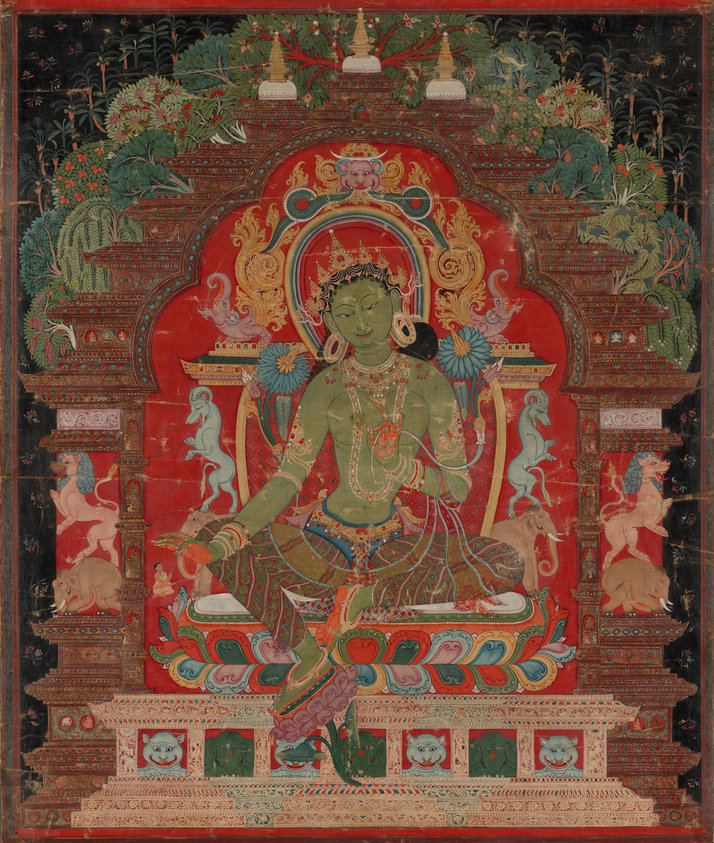
Green Tara
Aniko (attributed)
For Tibetans, Green Tara is one of the preeminent figures of their Buddhist faith, a radiant savioress who embodies the female form of the perfect, enlightened mind. The Green Tara in the Cleveland thangka—a Tibetan devotional painting on cloth—specifically dispels fear and provides protection, just like her mantra inscribed on the back side of the painting. Her green color and fear-not gesture link her to the cosmic Buddha of the North, enshrined above her head. Most scholars agree that this work was painted by the celebrated Nepalese artist known as Aniko.
Details
- Palette
-
Select a color to find related artworks.
- Dimensions
- overall: height 1.07 m, width 0.65 m; painting: height 0.524 m, width 0.432 m
- Origin
- Central Tibet
- Department
- Indian and Southeast Asian Art
- Holding institution
- Cleveland Museum of Art
- Image provider
- cleveland-museum-of-art
- License
- CC0-1.0
- Credit
- Purchase from the J. H. Wade Fund by exchange
Art Genome Taxonomy
12 tags
Subject Matter
-
Deities and Holy Figures Both · 99%
The title and museum description identify the central figure as Green Tara, a Buddhist savioress; the image presents a single sacred anthropomorphic figure at the compositional center.
-
Human Figure Both · 98%
The image visibly centers on a seated anthropomorphic figure with a human face, body, and hands, identified by the catalog as Green Tara.
-
Flora Visual · 99%
Flowering plants, leaves, vines, and numerous blossoms densely fill the upper and lateral areas of the composition.
-
Animals Visual · 94%
Paired elephant-like and lion-like creatures, along with other small animal or guardian-like forms, populate the architectural setting.
-
Symbolic Composition Both · 94%
The museum describes the work as a Tibetan devotional painting and specifically links Tara's color and gesture with protection and the dispelling of fear; the central deity, lotus throne, and ordered architectural framing visibly support a symbolic devotional composition.
Visual Qualities
-
Symmetrical Visual · 99%
The throne, architectural tiers, surrounding creatures, and ornamental elements are arranged with strong bilateral symmetry around the central figure.
-
Highly Ornamented Visual · 99%
The surface is extensively embellished with architectural ornament, jewelry, patterned garments, foliage, borders, and repeated decorative motifs.
Medium and Techniques
Time Periods
-
1000 - 1400 CE Art Metadata · 99%
The catalog dates the work to approximately the 1260s, within the 1000–1400 CE period.
Geographic Regions
-
Asian Art Metadata · 95%
The work originated in Central Tibet and is cataloged within the museum's Indian and Southeast Asian Art department.
Cultural and Religious Styles
-
Buddhist Art and Architecture Metadata · 99%
The museum identifies Green Tara as a preeminent figure of Tibetan Buddhist faith and describes the object as a Tibetan devotional painting.
Source & rights
Aniko (Nepalese, active in Tibet mid- to late 1200s). Green Tara. Cleveland Museum of Art.