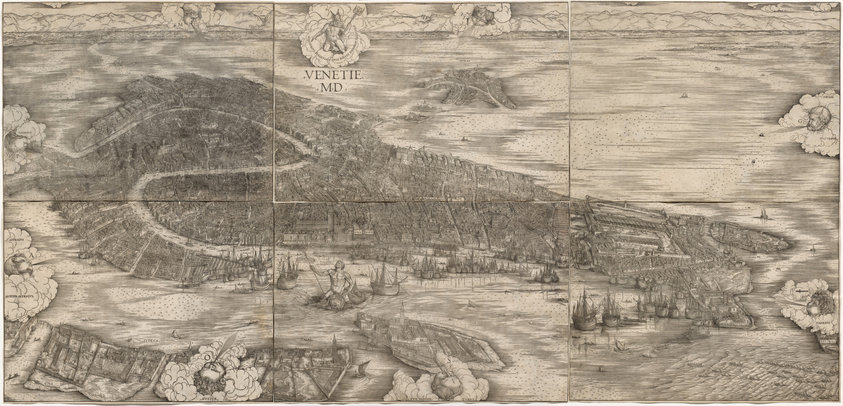
View of Venice
By the end of the 1400s, Venice had emerged as the major printing center in Europe, where books were printed in various languages to be shipped around the world. The city also became the great emporium for prints, and the woodcut developed beyond its humble origins as a popular art for devotional imagery, playing cards, and later for book illustration. View of Venice epitomizes this new ambitious scope for the woodcut, and is a landmark in the history of printmaking. This monumental print can be compared in scale only to a mural decoration and presumably served as a less expensive surrogate...
Details
- Palette
-
Select a color to find related artworks.
- Dimensions
- overall: height 1.327 m, width 2.775 m
- Origin
- Italy, early 16th Century
- Department
- Prints
- Holding institution
- Cleveland Museum of Art
- Image provider
- cleveland-museum-of-art
- License
- CC0-1.0
- Credit
- Purchase from the J. H. Wade Fund
Art Genome Taxonomy
12 tags
Subject Matter
-
Cityscapes and City Scenes Both · 99%
The image is an expansive view of Venice's dense built environment, islands, canals, waterfronts, and surrounding lagoon; the catalog identifies the work as a view of the city.
-
Waterscapes Both · 98%
The lagoon and waterways occupy large portions of the panorama, and the catalog emphasizes Venice's maritime setting and the entrance to the Grand Canal.
-
Maps/Networks Both · 96%
The city is organized as a comprehensive aerial survey of connected districts and waterways; the catalog explicitly describes the composite image as a map assembled from views recorded from multiple towers and buildings.
-
Modes of Transportation Both · 94%
Numerous sailing ships and smaller boats are distributed across the lagoon and waterways, and the catalog discusses Venice's seafaring trade activities.
-
Classical Mythology Metadata · 95%
The catalog identifies Mercury, god of commerce, and Neptune, god of the seas, as figures associated with the city and the entrance to the Grand Canal.
Visual Qualities
-
Highly Detailed Visual · 99%
The panorama is densely filled with individually rendered buildings, streets, ships, shoreline structures, hatching, and small linear marks across the water.
-
Black and White Visual · 97%
The composition is dominated by fine black or dark linear marks on a light ground, producing a largely monochrome appearance.
-
Emphasis on Linear Perspective Both · 90%
The image uses an elevated geometric system to organize the city and lagoon; the catalog describes a single but inconsistent perspective and an attempt to render the city according to geometric laws.
Medium and Techniques
-
Panorama Both · 96%
The work is a very wide six-part panorama, and the catalog records its monumental dimensions of 1.327 by 2.775 meters.
-
Woodcut and Linocut Metadata · 99%
The catalog identifies the medium as a woodcut from six blocks on six sheets of paper.
-
Prints Metadata · 99%
The museum classifies the object as a print and a woodcut.
-
Work on Paper Metadata · 99%
The catalog specifies that the six blocks were printed on six sheets of paper.
Source & rights
Jacopo de' Barbari (Italian, c. 1460/70–c. 1516). View of Venice. Cleveland Museum of Art.