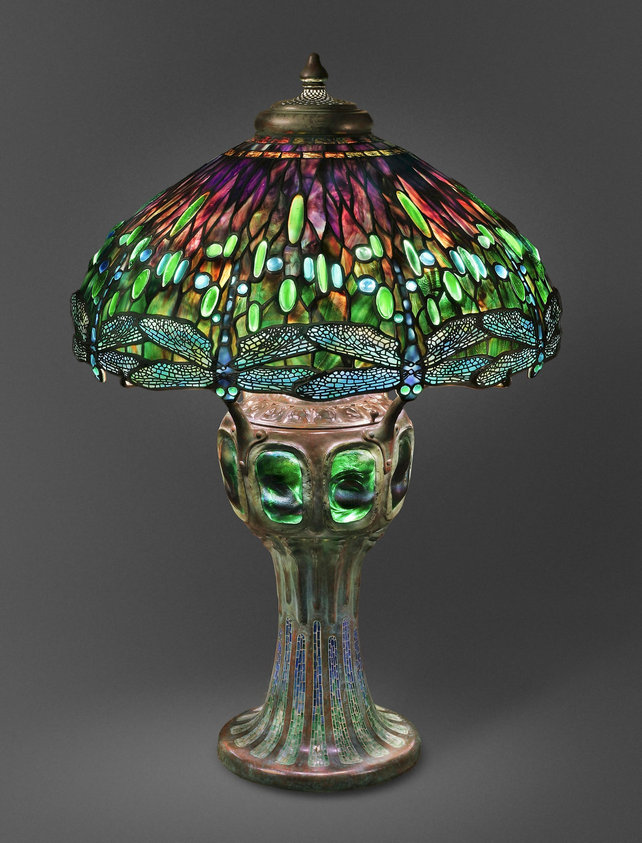
Lamp with Hanging Head Dragonfly Shade and Mosaic and Turtleback Base
In the 1890s Louis Comfort Tiffany began using his opalescent Favrile glass to produce lamps, the form for which he would become most famous. As the artistic director of Tiffany Studios, he approved all patterns but created relatively few lamps himself. Clara Driscoll, head of the Women’s Glass Cutting Department, designed the majority of the firm’s lamps, including, likely, this one.
Details
- Palette
-
Select a color to find related artworks.
- Medium
- Favrile glass and bronze
- Dimensions
- 86.4 × 57.2 cm (34 × 22 1/2 in.)
- Origin
- Corona
- Department
- Arts of the Americas
- Holding institution
- Art Institute of Chicago
- Image provider
- art-institute-chicago
- License
- CC0-1.0
- Credit
- Roger and J. Peter McCormick Endowments, Robert Allerton Purchase Fund, Goodman Endowment for the Collection of the Friends of American Art, Pauline S. Armstrong Endowment, Edward E. Ayer Endowment in memory of Charles L. Hutchinson; purchased with funds provided by the Antiquarian Society in memory of Helen Richman Gilbert and Lena Turnbull Gilbert, Sandra van den Broek, Mr. and Mrs. Henry M. Buchbinder, Quinn E. Delaney, Mr. and Mrs. Wesley M. Dixon, Jamee J. and Marshall Field, Celia and David Hilliard, Elizabeth Souder Louis, Mrs. Herbert A. Vance, and Mr. and Mrs. Morris S. Weeden
Art Genome Taxonomy
12 tags
Subject Matter
-
Animals Both · 99%
The shade visibly features a repeated frieze of dragonflies, and the museum lists dragonflies, insects, and animals among the subjects.
Styles and Movements
-
Art Nouveau Both · 97%
Art Nouveau is listed among the museum’s associated styles; the image displays organic insect motifs, flowing contours, and highly integrated ornamental decoration.
Design Movements
-
Arts and Crafts Movement Both · 96%
The museum associates the work with the Arts and Crafts Movement and the American Arts and Crafts Movement. Its emphasis on material variation, visible construction, and the appearance of handcraft also supports this catalog association.
Visual Qualities
-
Patterns Visual · 97%
The shade uses repeated dragonflies, radiating glass segments, rounded cabochon-like inserts, and regularly arranged mosaic strips on the stem and base.
-
Symmetrical Visual · 94%
The lamp has a centered vertical axis, a balanced domed shade, and a near-symmetrical stem and foot, although individual glass pieces vary in color and shape.
-
Bright and Vivid Colors Visual · 96%
The image shows saturated greens, turquoise blues, purples, reds, oranges, and pinks against dark metal outlines.
Medium and Techniques
-
Glass and Ceramics Both · 98%
The museum classifies the work as glass and identifies Favrile glass as its principal material; the image makes assembled, colored glass central to the object’s construction and appearance.
Time Periods
-
1900 - 1917 Art Metadata · 95%
The museum dates the work “By 1906” and records a date range of 1901–1911, placing it within the 1900–1917 period.
Geographic Regions
-
American Art Metadata · 96%
The artist and Tiffany Studios are identified as American, and the museum classifies the object as American decorative art.
Materials
-
Glass as Material Both · 99%
The museum specifies Favrile glass, and glass is visually dominant throughout the shade, cabochons, base panels, and mosaic strips.
-
Bronze Metadata · 94%
Bronze is specified as part of the medium; the image shows a dark metal framework, fittings, and foot surrounding and supporting the glass.
Furniture and Lighting
-
Lighting Both · 99%
The museum classifies the object as a lamp and lighting device, and the image clearly shows a complete lamp with shade, stem, and base.
Source & rights
Clara Driscoll. Lamp with Hanging Head Dragonfly Shade and Mosaic and Turtleback Base. The Art Institute of Chicago.