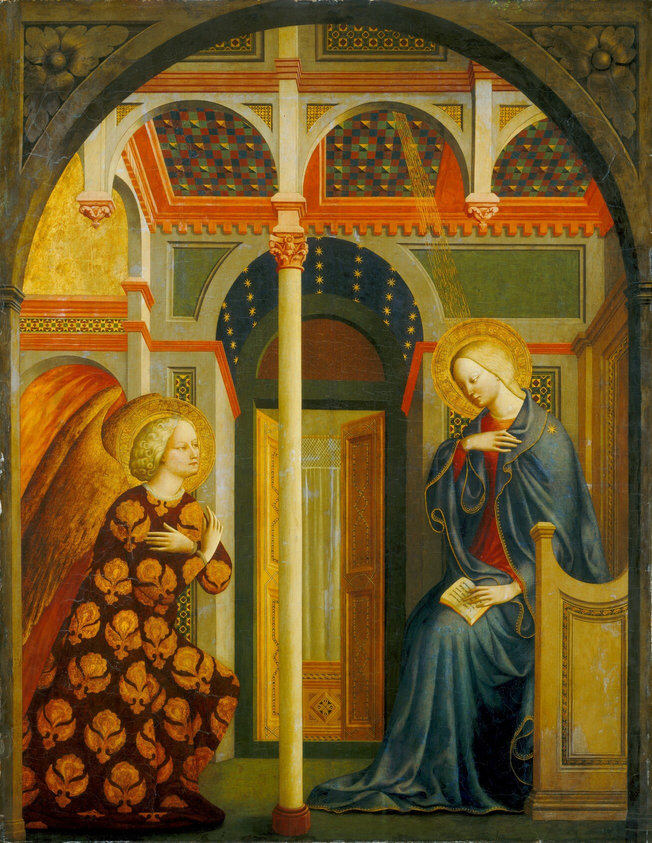
The Annunciation
A winged angel with arms crossed kneels across from a young woman sitting and holding a book, both under an archway in a paneled room in this vertical painting. They both have pale, yellow-toned skin, blond hair, and flat, gold halos. They also have golden brown eyes, long, straight noses, smooth cheeks, and their pale, pink lips are closed. To our right, the woman sits in a throne-like chair with her body facing our left. Her head tilts down, and she looks toward the angel under lowered lids. Her hair is pulled back under the neck of the lapis-blue cloak she wears over a crimson-red dress. The dress and cloak are trimmed with gold, and a there is a gold starburst on the cloak over her left shoulder, closer to us. She holds her other hand up near that shoulder with her fingertips brushing her chest. With her other hand, she holds open the pages of a small book in her lap, so her fingers overlap some of the words. The entire Latin inscription would read, “virgo concipiet et pariet filium et vocabitur nomen eius emmanuel butirum et mel come dit ut fiat reprobare.” A slender, bone-white column separates her from the angel across from her, along the left edge of the painting. The angel has curly, shoulder-length hair and wears a robe with a gold, floral pattern against a burgundy-red background. Long, golden wings emerge from the shoulder blades and extend off the side of the composition. An open archway just beyond the angel is filled with streaks of flax yellow and burnt orange, possibly representing flames. Some of the walls in the room around the pair are pale olive green and other areas are darker spruce green. There are bands of coral-pink molding and inset panels of patterned mosaics. The flat ceiling of the space immediately over the pair is decorated with checkerboard panels in navy blue, hunter green, brown, and brick red. Gold lines create a ray coming from the ceiling toward the woman. At the back of the space, beyond the column separating the woman and angel, the room extends into an alcove with an arched hallway painted with gold stars against a midnight-blue background. Double doors open at the back of the alcove onto a room with a pale-yellow curtain with a mesh-like trim. We see the pair as if through a stone archway that lines the top and sides of the composition. The upper corners are filled with leafy decorations, as if carved into the stone.
Details
- Palette
-
Select a color to find related artworks.
- Dimensions
- overall: 148.8 × 115.1 cm (58 9/16 × 45 5/16 in.) framed: 181.61 × 151.13 × 19.69 cm (71 1/2 × 59 1/2 × 7 3/4 in.)
- Department
- CIS-R
- Holding institution
- National Gallery of Art
- Image provider
- national-gallery-of-art
- License
- CC0-1.0
- Credit
- Andrew W. Mellon Collection
Art Genome Taxonomy
12 tags
Subject Matter
-
Bible Story Both · 99%
The title identifies the biblical Annunciation, and the image shows the Virgin Mary receiving the angel’s message.
-
Deities and Holy Figures Both · 98%
Mary and the angel are shown with halos; the angel also has wings and the scene includes a golden ray associated with the sacred encounter.
-
Narrative Both · 96%
The painting presents a legible encounter between two figures through their opposing positions, gestures, gazes, and the angel’s message.
-
Interiors Visual · 99%
The figures occupy a constructed architectural space with columns, arches, doors, moldings, patterned ceilings, and a throne-like chair.
-
Text Both · 96%
An open book with visible writing rests in Mary’s lap, and the catalog identifies an associated Latin inscription.
Styles and Movements
-
Early Renaissance Both · 88%
The work is dated c. 1423/1424 and displays formal features associated with Early Renaissance painting, including a structured architectural setting, sacred subject, tempera-like surface, and gold halos.
Visual Qualities
-
Highly Ornamented Visual · 98%
The composition is densely embellished with patterned architectural surfaces, floral garment motifs, gold borders, halos, mosaic-like panels, and carved-looking foliage in the enclosing arch.
-
Geometric Visual · 97%
Arches, columns, moldings, checkerboard-like ceiling panels, star patterns, and geometric door decoration create a strongly geometric framework.
-
Patterns Visual · 98%
Repeated decorative motifs appear across the ceiling, walls, garments, halos, borders, and architectural surfaces.
Medium and Techniques
-
Painting Metadata · 99%
The National Gallery of Art classifies the work as a painting and records its medium as tempera, possibly with oil glazes, on panel.
Time Periods
-
15th Century Art Metadata · 99%
The catalog dates the work to approximately 1423/1424, placing it in the fifteenth century.
Cultural and Religious Styles
-
Christian Art and Architecture Both · 99%
The Annunciation is a Christian subject, represented through Mary, the angel, halos, devotional text, and sacred imagery.
Source & rights
Masolino da Panicale. The Annunciation. Courtesy National Gallery of Art, Washington.