The Lacemaker
Anonymous Artist Johannes Vermeer
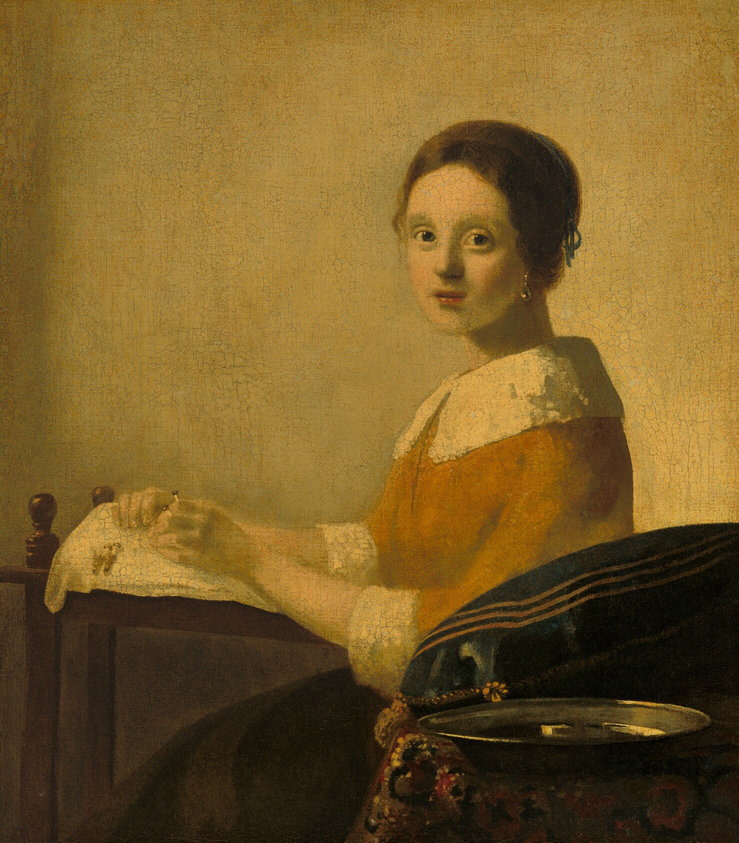
Painted almost entirely in tones of golden, mustard, and pale yellows, a young woman is shown from the lap up having turned to face us while making lace on a wooden frame in this vertical portrait painting. Her body faces our left almost in profile, but she turns her face to look at us with large, hazel-gray eyes. Her skin has a yellow cast but her smooth cheeks are lightly flushed, and her coral-red lips are parted. Her cinnamon-brown hair is parted down the middle and pulled back under a slate-blue ribbon, and she wears a teardrop-shaped earring in the ear we can see. Her burnt-orange shirt has pale yellow, wide cuffs at the elbow-length sleeves and a wide collar that rests across her chest and shoulders. The cuffs and collar are textured, suggesting fur. She rests her bare forearms against the wood frame in front of her, to our left, which is about the height of a table. A parchment-yellow cloth is draped over the frame, and she holds two short, cylindrical bobbins in her hands. Two more thread-wrapped bobbins hang to one side. The woman’s tea-brown skirt is partially hidden by a table situated closer to us, in the lower right corner of the painting. The table is covered with a patterned rug in maroon red, black, and gold. On the table are a low, wide pewter-gray bowl and a dark indigo-blue pillow with gold tassels and gold stripes near the seams. The wall behind the woman is honey yellow.
Details
- Palette
-
Select a color to find related artworks.
- Medium
- oil on canvas
- Dimensions
- overall: 44.5 x 40 cm (17 1/2 x 15 3/4 in.) framed: 67.3 x 61.9 x 9.5 cm (26 1/2 x 24 3/8 x 3 3/4 in.)
- Department
- CNE-B
- Holding institution
- National Gallery of Art
- Image provider
- national-gallery-of-art
- License
- CC0-1.0
- Credit
- Andrew W. Mellon Collection
Art Genome Taxonomy
10 tags
Subject Matter
-
Individual Portrait Both · 99%
The image shows a single woman presented in a vertically oriented portrait-like composition, and the catalog describes the work as a vertical portrait painting.
-
Eye Contact Visual · 99%
The woman turns her face toward the viewer and establishes a direct gaze, making eye contact a prominent feature of the composition.
-
Work and Workers Both · 99%
The woman is visibly engaged in lace-making, with her forearms, bobbins, thread, and wooden work frame shown; the catalog explicitly identifies the activity as making lace.
-
Interiors Visual · 88%
The honey-colored wall, furniture-like foreground forms, work frame, bowl, cushion, and textiles create the appearance of a domestic interior.
-
References to Art History Metadata · 99%
The catalog displays the attribution as “Imitator of Johannes Vermeer,” establishing an explicit art-historical relationship to Vermeer rather than an unqualified attribution to him.
Visual Qualities
-
Earth Tones Visual · 99%
Ocher, mustard, honey, brown, burnt-orange, and deep blue-black tones dominate the image.
-
Cracked Visual · 99%
Extensive fine craquelure is visibly distributed across the wall, figure, clothing, and foreground objects.
Medium and Techniques
-
Oil Painting Metadata · 99%
The National Gallery of Art identifies the medium as oil on canvas.
Time Periods
-
1918 - 1939 (Interwar) Art Metadata · 98%
The catalog dates the work c. 1925, placing it within the 1918–1939 interwar period.
Textiles
-
Textile Arts Both · 97%
Lace-making, bobbins, thread, a textile-draped frame, and patterned fabric make textile production a central subject of the image and catalog description.
Source & rights
Imitator of Johannes Vermeer. The Lacemaker. Courtesy National Gallery of Art, Washington.