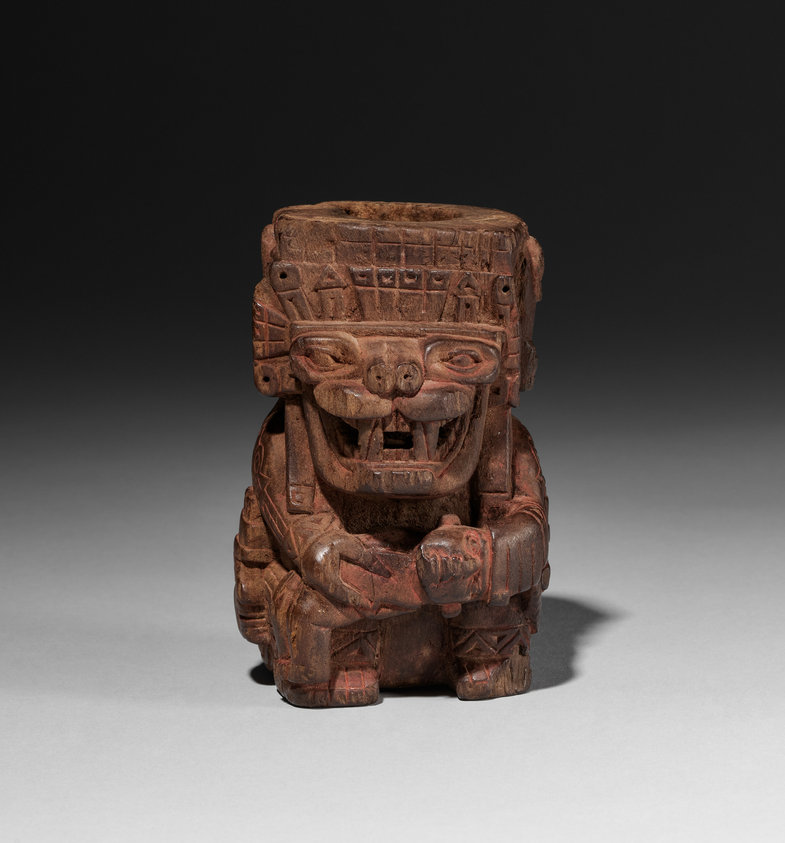
Sacrificer Container
This container assumes the shape of a magnificent, feline-headed, supernatural sacrificer who draws a knife across the throat of the human it holds in its lap. Severed human heads hang from the feline's belt and dangle by the trachea at the back of its headdress. Sacrifice had a place in Wari religious practice, probably as an unusual and exceptionally precious offering made to entice the benevolence of cosmic forces. Indeed, colonial-period Andean people believed that death was a prerequisite for the renewal of the world.
Details
- Palette
-
Select a color to find related artworks.
- Medium
- wood and cinnabar
- Dimensions
- overall: height 0.108 m, width 0.07 m, depth 0.075 m
- Department
- Art of the Americas
- Holding institution
- Cleveland Museum of Art
- Image provider
- cleveland-museum-of-art
- License
- CC0-1.0
- Credit
- John L. Severance Fund
Art Genome Taxonomy
10 tags
Subject Matter
-
Zoomorphism Both · 96%
The image shows a feline-like head on a humanlike seated body, while the museum describes the figure as a feline-headed supernatural sacrificer.
-
Human Figure Both · 91%
A smaller figure is enclosed by the larger figure's arms in the image, and the museum identifies the held figure as a human.
-
Mythology and Religion Metadata · 96%
The museum explicitly connects the supernatural sacrificer and its sacrificial imagery to Wari religious practice and Andean beliefs concerning cosmic renewal.
-
Violence Metadata · 99%
The museum description explicitly identifies a knife drawn across the held person's throat and severed human heads attached to the figure.
Medium and Techniques
-
Sculpture Both · 98%
The object is a fully three-dimensional carved figure with modeled facial features, limbs, and a vessel opening at the top; the museum classifies it as wood.
-
Carving Both · 99%
Raised and recessed forms, incised lines, and modeled geometric and bodily details are visibly carved into the wooden object.
Time Periods
-
500 - 1000 CE Art Metadata · 97%
The museum dates the object to 770–890, which falls within the 500–1000 CE period category.
Geographic Regions
-
Andes Region Art Metadata · 99%
The recorded place of origin is the Central Andes, and the work is identified as Wari style.
Materials
-
Wood Metadata · 99%
The museum lists the medium as wood and cinnabar and classifies the work as Wood.
Tableware, Vessels, and Objects
-
Container Both · 99%
The museum title identifies it as a container, and the image clearly shows a hollow opening within the thick upper rim.
Source & rights
Unknown artist. Sacrificer Container. Cleveland Museum of Art.