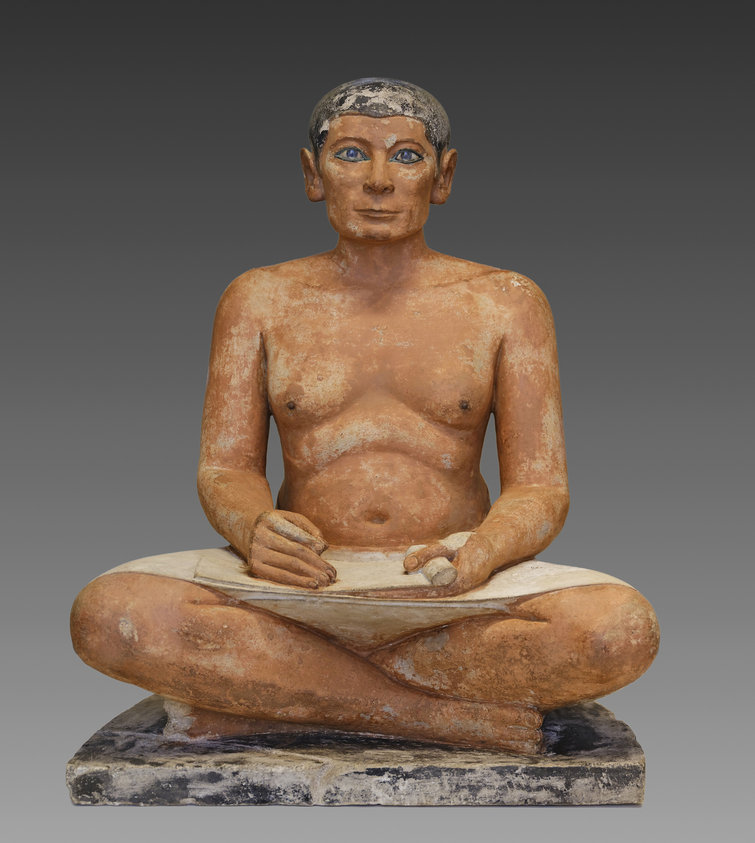
Le scribe accroupi
homme (scribe, assis en tailleur, pagne, cheveux ras, écrivant, tenant, rouleau de papyrus)
Details
- Palette
-
Select a color to find related artworks.
- Dimensions
- Hauteur 53,7 cm; Largeur 44 cm; Profondeur 35 cm
- Department
- Département des Antiquités égyptiennes
- Holding institution
- Musée du Louvre
- Image provider
- wikimedia-commons
- License
- CC0
- Credit
- Musée du Louvre, Département des Antiquités égyptiennes
Art Genome Taxonomy
10 tags
Subject Matter
-
Human Figure Both · 99%
The work depicts a single modeled human body, identified in the catalog as a male scribe.
-
Work and Workers Both · 96%
The figure is shown holding a writing implement over a pale writing surface, and the catalog identifies him as a scribe who is writing.
Visual Qualities
-
Symmetrical Visual · 90%
The figure is presented frontally with a strongly bilateral head, torso, and seated arrangement, despite the differing positions of the hands.
Medium and Techniques
Time Periods
-
Ancient Art Metadata · 99%
The catalog dates the work to Egypt’s Fourth Dynasty, approximately 2675–2545 BCE.
Geographic Regions
-
Egyptian Art Metadata · 99%
The catalog identifies the work as an Egyptian antiquity held by the Musée du Louvre’s Department of Egyptian Antiquities.
Materials
-
Stone Both · 99%
The figure and rectangular base have the appearance of carved stone, and the catalog specifies limestone as the principal material.
-
Inlay Both · 98%
The eyes and their contours are visibly distinct from the surrounding painted surface, and the catalog identifies inlaid Egyptian alabaster, rock crystal, and copper in these areas.
Cultural and Religious Styles
-
Ancient Egypt Both · 99%
The object is an ancient Egyptian figure sculpture, and the catalog places it in the Egyptian Antiquities department and dates it to the Fourth Dynasty.
Source & rights
Shonagon