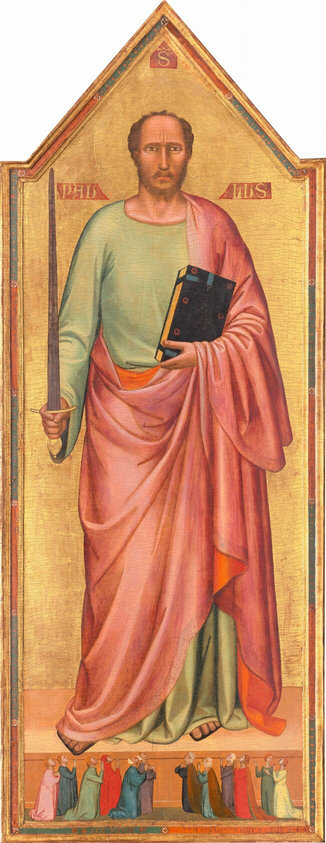
Saint Paul and a Group of Worshippers
Against a shiny gold background, a man with peach-colored skin nearly fills this tall, narrow, vertical panel above a row of twelve people, significantly smaller in scale, kneeling by his feet and looking up at the man, their hands together in prayer. The top of the panel comes to a point above the man’s head. His body faces us, and he looks at us with brown eyes under furrowed, dark eyebrows. His nose is long and straight, and his mouth is small with a rosy lower lip. He has a brown, trimmed beard, and his hair is receding. He holds up a gold-handled sword with a slate-gray blade in his right hand, on our left, while in his other hand, he cradles a thick black book with a gold-edged pages against his chest. The man wears a floor-length, celery-green tunic with a flowing, rose-pink robe over his left shoulder, on our right, and around his body. The robe is lined with tangerine orange and has a faint, patterned border. The toes of his sandaled feet stick out. On a smaller scale, along the bottom of the painting, six pairs of people kneel facing the center, three couples to each side. Eleven of the people gaze with heads tipped back, up at the man with their hands folded in prayer. To our right, one woman turns and gestures, mouth open, to her neighbor. Their long robes are painted in shades of shell pink, indigo blue, scarlet red, butter yellow, sage green, and chestnut brown. Some wear white fabric over their hair while others are bareheaded. The gold background is incised around the man’s head to create a halo. Molding and a band of alternating strips of slate blue and brick red enclose the pointed panel. Three shapes, like small banners, are painted in red with gold lettering around the man’s head, with an “S” at the top center, “PAU” over his shoulder to our left, and “LUS” to our right. In the blue and red band set into the frame at the lower center, an inscription reads, “NI.MCCCXXXIII M II.ESPLETUM FUIT HC OPUS.” There is a noticeable network of cracks across the painting’s surface, especially on the gold background behind the man.
Details
- Palette
-
Select a color to find related artworks.
- Medium
- tempera on panel
- Dimensions
- painted surface: 224.8 × 77 cm (88 1/2 × 30 5/16 in.) overall: 233.53 × 88.8 × 5.3 cm (91 15/16 × 34 15/16 × 2 1/16 in.)
- Department
- CIS-R
- Holding institution
- National Gallery of Art
- Image provider
- national-gallery-of-art
- License
- CC0-1.0
- Credit
- Andrew W. Mellon Collection
Art Genome Taxonomy
11 tags
Subject Matter
-
Saints Both · 100%
The title identifies Saint Paul, and the central haloed figure is visibly represented with a sword, book, and Christian devotional attributes.
-
Human Figure Visual · 99%
A monumental standing human figure occupies most of the tall panel, with twelve smaller kneeling human figures arranged along the bottom.
Styles and Movements
-
Medieval Art Both · 98%
The work is dated 1333, and its pointed panel, gold ground, halo, inscriptions, and devotional hierarchy are consistent with medieval panel painting.
Visual Qualities
-
Balance Visual · 94%
The centered frontal figure and balanced groups of kneeling worshippers create a stable, strongly organized composition despite the figure’s asymmetrical attributes and drapery.
-
Highly Ornamented Both · 95%
The patterned frame, incised halo, gold ground, colored inscription banners, and elaborately rendered garments make the surface highly decorative.
-
Cracked Both · 100%
A pronounced network of fine cracks is visible across the gold ground and other painted areas, and the catalog specifically notes cracking across the surface.
-
Shiny/Glossy Both · 90%
The catalog describes a shiny gold background, which appears luminous and reflective-looking around the saint in the image.
Medium and Techniques
Time Periods
-
1000 - 1400 CE Art Metadata · 100%
The catalog gives the date as 1333, placing the work within the 1000–1400 CE period.
Cultural and Religious Styles
-
Christian Art and Architecture Both · 99%
The panel depicts Saint Paul, prayer, a halo, and sacred inscriptions, supported by both the title and the visible Christian imagery.
Source & rights
Bernardo Daddi. Saint Paul and a Group of Worshippers. Courtesy National Gallery of Art, Washington.