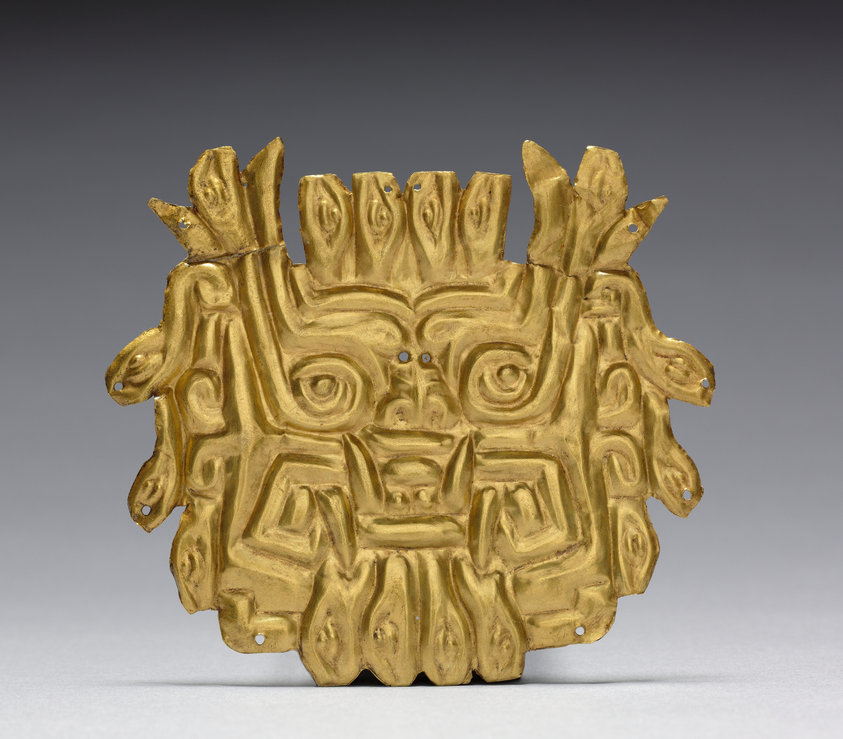
Plaque
These plaques showing a powerful Chavín deity may come from a group of gold objects found in a lavish tomb in the 1920s. One is shaped as the deity’s fanged head, its fur transformed into sixteen serpents that edge the plaque. On the other, the deity’s visually elusive body also appears: the clawed hands over the chest may clutch a horizontal staff, an emblem of authority; across the waist is a belt that sprouts serpents; and beneath are the legs and feet, which stand atop fanged masks.
Details
- Palette
-
Select a color to find related artworks.
- Medium
- hammered and cut gold
- Dimensions
- overall: height 0.125 m, width 0.138 m
- Department
- Art of the Americas
- Holding institution
- Cleveland Museum of Art
- Image provider
- cleveland-museum-of-art
- License
- CC0-1.0
- Credit
- Dudley P. Allen Fund
Art Genome Taxonomy
9 tags
Artistic Disciplines
-
Jewelry Metadata · 99%
The museum classifies the object as Jewelry; its small hammered-gold plaque format is consistent with an ornamental object, although its original function is not specified.
Subject Matter
-
Deities and Holy Figures Metadata · 99%
The catalog explicitly identifies the represented figure as a powerful Chavín deity.
-
Face Both · 99%
A dominant frontal face occupies the center of the plaque, with large rounded eyes, a central nose, and a broad mouth with fanged forms; the catalog describes the object as the deity’s fanged head.
-
Animals Both · 97%
Repeated elongated and scrolling forms surround the head; the catalog identifies these forms as sixteen serpents, and their animal-like shapes are visible around the plaque’s upper and lateral edges.
Visual Qualities
-
Symmetrical Both · 97%
The composition is organized around a strong vertical axis, with paired eyes and broadly balanced repeated motifs on the two sides.
Medium and Techniques
-
Relief Visual · 95%
The thin plaque has raised modeled contours and incised channels that project from and articulate a relatively flat gold surface.
Time Periods
-
Ancient Art Metadata · 98%
The catalog dates the plaque to approximately 500–200 BCE, placing it within Ancient Art.
Materials
-
Gold Metadata · 99%
The museum specifies hammered and cut gold; the image also visibly shows a reflective yellow-gold surface.
Cultural and Religious Styles
-
Pre-Columbian Art Metadata · 98%
The catalog places the work in Peru’s North Coast and identifies it as Chavín style, dating it to approximately 500–200 BCE; this is pre-Columbian art.
Source & rights
Unknown artist. Plaque. Cleveland Museum of Art.