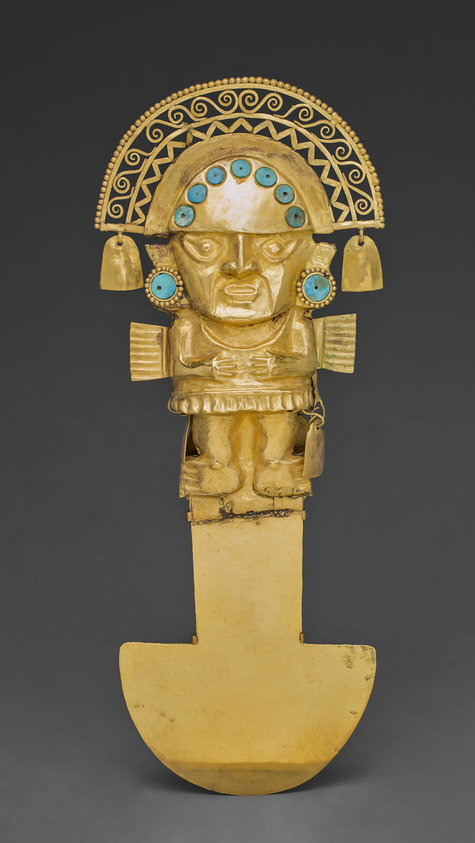
Ceremonial Knife (Tumi)
Naymlap, the heroic founder-colonizer of the Lambayque Valley on the north coast of Peru, is thought to be the legendary figure represented on the top of this striking gold tumi (ceremonial knife). It would have been carried by a dynastic ruler during state ceremonies to represent, in a more precious form, the copper knives used for animal sacrifices.
Details
- Palette
-
Select a color to find related artworks.
- Medium
- Gold with turquoise inlay
- Dimensions
- 34 × 12.7 cm (13 3/8 × 5 in.)
- Origin
- Lambayeque Valley
- Department
- Arts of the Americas
- Holding institution
- Art Institute of Chicago
- Image provider
- art-institute-chicago
- License
- CC0-1.0
- Credit
- Ada Turnbull Hertle Endowment
Art Genome Taxonomy
12 tags
Subject Matter
-
Human Figure Both · 99%
A frontal standing human figure forms the upper portion of the knife; the museum describes the figure’s face, arms, body, and splayed feet.
Visual Qualities
-
Symmetrical Visual · 98%
The frontal figure, semicircular headdress, paired ear ornaments, pendant elements, and central blade are organized around a strong vertical axis.
-
Geometric Visual · 95%
The headdress includes repeated triangular and spiral motifs, while the blade and figure are defined by simplified, clearly bounded forms.
-
Highly Ornamented Visual · 99%
The object includes an openwork headdress with beaded borders, scrollwork, triangular patterning, turquoise settings, large ear ornaments, and hanging pendants.
Medium and Techniques
-
Relief Both · 95%
The face, torso, hands, feet, and regalia project from the surface in modeled relief, consistent with the museum’s description of repoussé construction.
Time Periods
-
Pre-20th Century Art Metadata · 99%
The documented date range is 1100–1470, well before the twentieth century.
Geographic Regions
-
Andes Region Art Metadata · 99%
The museum places the work in the Lambayeque Valley on Peru’s north coast and identifies its cultural context as Andean.
Materials
-
Metal Metadata · 100%
The museum classifies the work as metalwork and identifies gold as its principal medium.
-
Gold Metadata · 100%
The catalog explicitly identifies the medium as gold with turquoise inlay.
-
Gemstone Both · 98%
The catalog identifies turquoise inlay, which is visibly prominent in the headdress and ear ornaments.
Antiquities, Artifacts, and Religious Objects
-
Ceremonial Object Both · 99%
The museum classifies the work as a ceremonial object and describes its use in state ceremonies; the image shows a richly ornamented anthropomorphic knife intended for formal display or ritual use.
-
Arms and Armor Both · 90%
The catalog identifies the object as a ceremonial knife, and the image clearly shows a broad blade integrated with the upper figure and handle structure. Its documented ceremonial function does not imply battlefield use.
Source & rights
Chimú. Ceremonial Knife (Tumi). The Art Institute of Chicago.