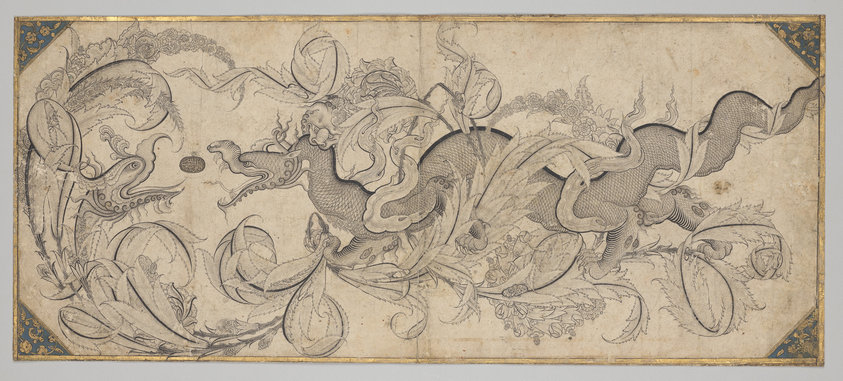
Dragon in foliage with lion and phoenix heads
Sahkulu (attributed)
A dragon lunges toward a pearl in the form of a seal inscribed with a verse from the Koran: “And I commit my case unto God” (40:44). In his front claw, the dragon grasps two flowering branches that magically produce a variety of blooms, including a lion that bites the dragon’s neck and a phoenix, who competes for the pearl. Sahkulu was trained by Persian artists, as were many artists of Mughal India during the 1500s. He joined the Ottoman imperial painting atelier in Istanbul in 1526 and became the head in 1545.
Details
- Palette
-
Select a color to find related artworks.
- Dimensions
- sheet: height 0.173 m, width 0.402 m
- Origin
- Ottoman Turkey, Istanbul
- Department
- Islamic Art
- Holding institution
- Cleveland Museum of Art
- Image provider
- cleveland-museum-of-art
- License
- CC0-1.0
- Credit
- Purchase from the J. H. Wade Fund
Art Genome Taxonomy
11 tags
Subject Matter
-
Animals Both · 99%
The composition includes a dragon, a lion, and a phoenix; the museum description explicitly identifies these animal forms.
-
Hybrids and Imaginary Creatures Both · 99%
The dragon and phoenix are fantastical creatures, and the museum catalog explicitly names both forms.
-
Flora Both · 99%
Flowering branches, leaves, buds, and numerous stylized blossoms occupy much of the sheet and are specifically described in the catalog.
-
Related to Religion Metadata · 98%
The pearl-shaped seal bears a verse from the Koran: “And I commit my case unto God” (40:44).
-
Narrative Metadata · 97%
The catalog describes an active encounter in which the dragon lunges toward the seal, the lion bites its neck, and the phoenix competes for the pearl.
Medium and Techniques
-
Drawing Metadata · 99%
The museum classifies the object as a drawing and specifies ink, gum tempera, and gold on paper.
Time Periods
-
16th Century Art Metadata · 99%
The work is dated to the mid-1500s, and the artist is recorded as active from 1526 to 1556.
Materials
-
Use of Paper Metadata · 99%
The catalog identifies paper as the support and gives the sheet dimensions as approximately 17.3 by 40.2 cm.
-
Gold Both · 99%
Gold is explicitly listed in the medium and is visibly present along the border and in selected ornamental details.
Cultural and Religious Styles
-
Ottoman Art Metadata · 99%
The museum identifies the place of origin as Ottoman Turkey, Istanbul, and records the artist’s work in the Ottoman imperial painting atelier.
-
Islamic Art and Architecture Metadata · 97%
The Cleveland Museum of Art classifies the work as Islamic Art.
Source & rights
Sahkulu (Turkish, active 1526–56). Dragon in foliage with lion and phoenix heads. Cleveland Museum of Art.