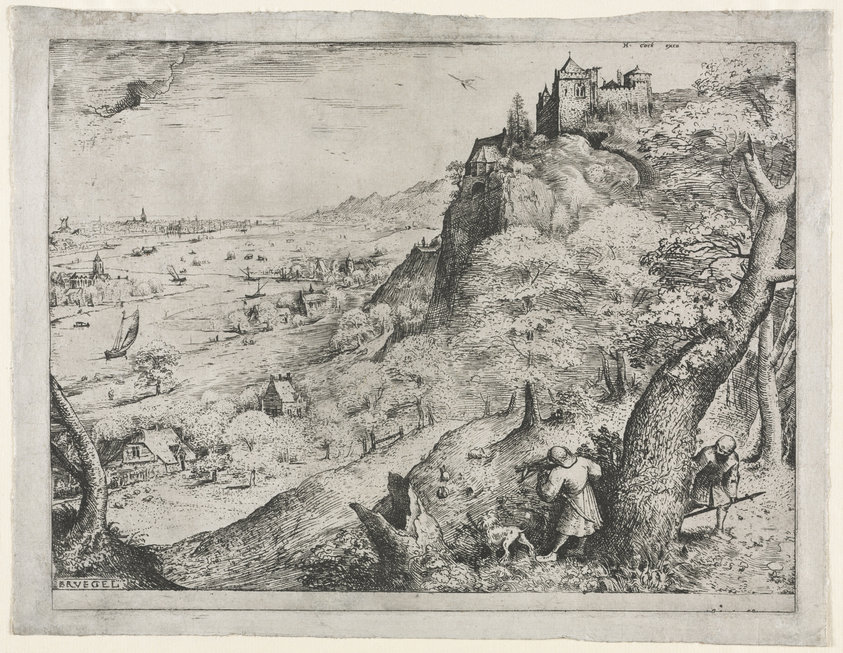
The Rabbit Hunt
In this etching considered the artist's only autograph print, Pieter Bruegel the Elder replicated the graphic vocabulary of dots and dashes of his pen-and-ink drawings to evoke a vivid sense of atmosphere and light and create a deep recession into space. His representations of nature, including majestic mountains—an unusual and popular subject in the flat Netherlands—exemplify an unprecedented naturalism that the artist helped to usher in. What at first appears to be a pleasant landscape with a hunter aiming his crossbow at some rabbits in the grass becomes more ominous when we notice the s...
Details
- Palette
-
Select a color to find related artworks.
- Medium
- etching
- Dimensions
- sheet: height 0.243 m, width 0.318 m; platemark: height 0.221 m, width 0.29 m
- Origin
- Flanders
- Department
- Prints
- Holding institution
- Cleveland Museum of Art
- Image provider
- cleveland-museum-of-art
- License
- CC0-1.0
- Credit
- Purchase from the J. H. Wade Fund
Art Genome Taxonomy
12 tags
Subject Matter
-
Landscapes and Waterscapes Both · 99%
The image shows an expansive hilly landscape adjoining a broad body of water, and the museum catalog identifies the work as one of Bruegel’s representations of nature and mountains.
-
Implied Narrative Both · 99%
The hunter, rabbits, and spear-bearing figure form a sequential action whose reversal is explicitly described in the museum catalog.
-
Animals Both · 95%
Several small rabbits are visible in the foreground, and the catalog identifies them as the hunter’s intended prey.
-
Figures in Nature Visual · 97%
The hunter and pursuing figure are embedded within the wooded and hilly landscape rather than presented as isolated figures.
Visual Qualities
-
Black and White Visual · 99%
The image is rendered in black ink and pale paper tones, with tonal variation created by line density rather than color.
-
Highly Detailed Visual · 98%
Fine, dense linework describes foliage, tree bark, terrain, architecture, boats, and distant activity throughout the sheet.
-
Emphasis on Linear Perspective Visual · 94%
Slopes, shorelines, paths, and successive landscape planes guide the eye from the foreground toward the distant horizon.
Medium and Techniques
-
Long Distance and Deep Distance Visual · 98%
Layered foreground, middle-distance, and far-distance terrain, shoreline, settlements, boats, and horizon create pronounced spatial recession.
-
Etching/Engraving Metadata · 100%
The museum catalog identifies the medium as etching.
-
Prints Metadata · 100%
The museum classifies the object as a print and places it in the Prints department.
Time Periods
-
16th Century Art Metadata · 100%
The catalog dates the print to 1560.
Geographic Regions
-
Flanders and Luxembourg Metadata · 99%
The catalog gives Flanders as the place of origin.
Source & rights
Pieter Bruegel (Netherlandish, c. 1525/30–1569). The Rabbit Hunt. Cleveland Museum of Art.