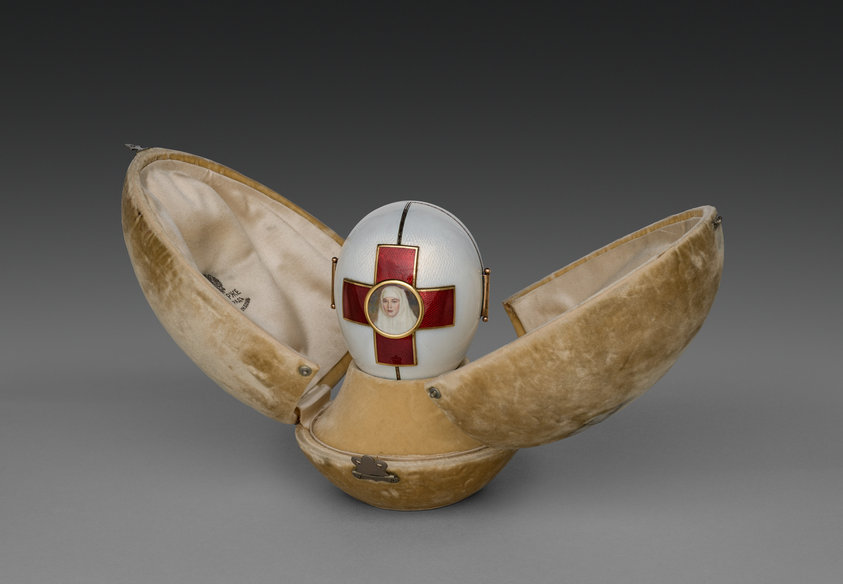
Imperial Red Cross Easter Egg
Peter Carl Fabergé Henrik Wigström House of Fabergé
The House of Fabergé made two imperial Easter eggs in 1915 that honored the contributions of Tsarina Alexandra and her two eldest daughters, Olga and Tatiana, to the war effort as Red Cross Sisters of Mercy. Compared to other Fabergé eggs elaborately ornamented with jewels, the eggs reflected the mood of austerity in Russia during World War I. This version becomes an icon when opened, revealing miniatures of the patron saints of the tsarina’s daughters. After the Russian Revolution, this relic of the Tsarist past was sold by the Soviet government to raise needed cash for the treasury.
Details
- Palette
-
Select a color to find related artworks.
- Dimensions
- overall: height 0.086 m, width 0.064 m
- Origin
- Russia, St. Petersburg
- Department
- Decorative Art and Design
- Holding institution
- Cleveland Museum of Art
- Image provider
- cleveland-museum-of-art
- License
- CC0-1.0
- Credit
- The India Early Minshall Collection
Art Genome Taxonomy
12 tags
Artistic Disciplines
-
Design Both · 99%
The catalog classifies the work as Decorative Art and Design, while the image shows a carefully engineered luxury object with an enclosing case, hinges, fittings, and an ornamental central egg.
Subject Matter
-
War and Military Metadata · 98%
The catalog explicitly associates the egg with World War I and with Alexandra, Olga, and Tatiana’s work as Red Cross Sisters of Mercy.
-
Related to Religion Metadata · 94%
The object is identified as an Easter egg, and the catalog states that it reveals miniatures of the patron saints of the tsarina’s daughters.
-
Portrait Visual · 92%
A painted circular portrait miniature is clearly visible at the center of the red cross on the central egg.
Visual Qualities
-
Symmetrical Visual · 96%
The central egg and cross are organized around strong vertical and horizontal axes, and the opened case presents a broadly balanced composition.
Medium and Techniques
-
Miniature and Small-Scale Paintings Both · 88%
The image visibly presents a small painted portrait miniature, while the catalog describes an interior program of saint miniatures.
Materials
-
Enamel Metadata · 98%
Enamel is explicitly listed in the catalogued medium and is visible as the highly finished colored surface of the central egg and cross.
-
Gold Metadata · 96%
Gold is explicitly listed in the catalogued medium; gold-colored borders, fittings, and framing are visible throughout the object.
-
Silver Metadata · 90%
The catalog identifies silver gilt as one of the object’s materials, although the image alone cannot distinguish it reliably from other gilt metal components.
-
Glass as Material Both · 90%
Glass is explicitly listed in the catalogued medium, and the portrait miniature appears to be protected by a transparent, reflective cover.
-
Ivory Metadata · 86%
Ivory is explicitly listed in the catalogued medium, though its location within the object is not distinguishable from the photograph.
Tableware, Vessels, and Objects
-
Container Both · 94%
The opened egg functions as an enclosing object that contains and reveals interior miniatures; its hinged shell, clasp, and fitted interior are visible in the image.
Source & rights
Peter Carl Fabergé (Russian, 1846–1920). Imperial Red Cross Easter Egg. Cleveland Museum of Art.