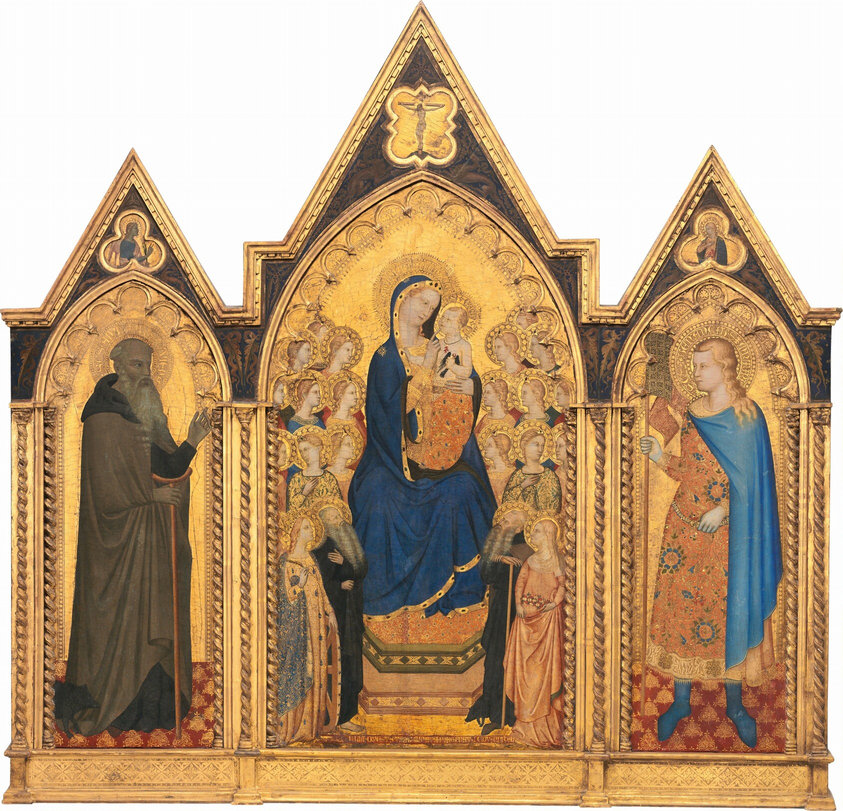
Madonna and Child Enthroned with Four Saints and Eighteen Angels [middle panel]
Puccio di Simone Allegretto Nuzi
This altarpiece is made up of three panels, with a single man standing in each of the narrow wings to the left and right and a wider panel at the center, which shows a woman holding a baby as twenty-two people look on. The background behind all the people is gold, and the top of each panel comes to a rounded, pointed arch under a second taller, sharper point. Spiraling columns frame the left and right sides, and rows of semicircular shapes, like inverted scallops, run inside the curving arches. In the central panel, the woman, child, and people around them all have pale skin and blond hair except for two elderly men with gray hair and beards. They all have plate-like gold halos that overlap, sometimes obscuring the face of another person. The woman and child, Mary and Jesus, sit on an unseen chair on two wide steps. They gaze at each other while Mary gently touches Jesus’s chin. Her lapis-blue mantle covers her hair and wraps around her body. The robe is edged with gold and has gold starbursts on one shoulder and on the crown of her head. Jesus’s garment is patterned with blue and gold against a dark orange background, and it wraps around his lower body. He holds a bird in one hand, touches Mary’s robe with the other, and a piece of coral hangs from a cord around his neck. Most of the people on each side wear azure-blue, pale peach, or brick-red garments decorated with gold. There are three inscriptions in this central panel. Mary’s halo is inscribed with “SCA MARIA MATER DEI” and Jesus’s halo reads, “IIS XRO M.” A third inscription across the bottom of the panel is partially damaged, but some of it reads, “LIIII QUESTA TA ATTA FRE FRATE GIOVANNI DA.” In the wing to our left, a balding, bearded man wearing a brown cloak over a black robe stands facing our right almost in profile. His pale skin has a dark, ash-gray cast. The hood of the black robe lies across his shoulders. He holds a wooden crutch with a curved top in the hand closer to us, and holds up his other hand with his palm facing us, fingers slightly curled in. A halo around his head is incised into the gold background and is filled with letters reading, “SaS ANTONIVS O VIENA.” Nearly lost against his dark robes, a black boar or pig stands near his feet. The floor here and in the right panel have a brocade-like pattern with three-lobed, gold designs against a field of brick red. The right wing is filled by a blond, cleanshaven young man standing facing our left as he looks toward Mary and Jesus in the center. He wears a long orange tunic decorated with blue flowers, and has a peacock-blue cloak and matching boots. Flags patterned with gold against black or red backgrounds flutter from a staff he holds with his right hand, farther from us. His other hand rests on the gold belt at his waist. His inscribed halo reads, “SCS. VENANCIVS MRTIRI.” The three panels are separated by spiraling gold columns and topped with triangular gables. The gables are filled with stylized leaves and animals in muted shades of brown against a black background. Near the pointed tops of the panels, the side wings have three-lobed shapes filled with a winged angel on the left and a person with a halo holding a hand to the chest on the right. The central gable has a four-lobed shape showing a man hanging on a cross.
Details
- Palette
-
Select a color to find related artworks.
- Medium
- tempera on panel
- Dimensions
- painted surface: 108 x 57.8 cm (42 1/2 x 22 3/4 in.) overall (with cradle): 108.5 × 59.5 × 3.2 cm (42 11/16 × 23 7/16 × 1 1/4 in.) framed: 150.5 x 66.7 x 8.3 cm (59 1/4 x 26 1/4 x 3 1/4 in.)
- Department
- CIS-R
- Holding institution
- National Gallery of Art
- Image provider
- national-gallery-of-art
- License
- CC0-1.0
- Credit
- Andrew W. Mellon Collection
Art Genome Taxonomy
12 tags
Subject Matter
-
Madonna and Child Both · 100%
Mary holds the infant Jesus at the center, and the catalog title and description explicitly identify the subject as the Madonna and Child.
-
Saints Both · 99%
The catalog identifies Saints Anthony and Venantius in the wings and describes the central assembly of saints and angels; multiple haloed holy figures are visible in the image.
Styles and Movements
-
Medieval Art Both · 98%
The work is dated 1354, and its gold-ground devotional imagery, haloed figures, and Gothic architectural framing are characteristic of medieval religious painting.
Visual Qualities
-
Highly Ornamented Visual · 99%
The surface is densely covered with halos, inscriptions, patterned textiles, decorative borders, architectural ornament, and gold-colored grounds.
-
Patterns Visual · 98%
Repeated brocade-like textile designs, floral and foliate motifs, patterned floors, halo ornament, and geometric borders create an extensive pattern system across the panels.
-
Dense Composition Visual · 96%
The central panel contains a crowded, overlapping assembly of haloed figures, while the wings and gables are also filled with figures and ornament.
-
Flatness Visual · 93%
The figures and architectural compartments are presented against a largely non-receding gold ground, with spatial organization conveyed mainly through overlapping figures, steps, and framing rather than naturalistic depth.
Medium and Techniques
-
Altarpiece Both · 99%
The National Gallery of Art identifies the work as an altarpiece, and the image visibly shows a tripartite devotional structure with a central panel, side wings, gables, and architectural framing.
-
Painting Metadata · 99%
The catalog classifies the work as a painting and records its medium as tempera on panel; the image visibly presents a painted panel object.
-
Tempera Metadata · 100%
The catalog specifies the medium as tempera on panel.
Time Periods
-
1000 - 1400 CE Art Metadata · 100%
The catalog date of 1354 places the work within the 1000–1400 CE period category.
Cultural and Religious Styles
-
Christian Art and Architecture Both · 100%
The catalog identifies a Christian devotional subject, while the image shows Mary, Jesus, saints, angels, halos, and a Crucifixion scene in the central gable.
Source & rights
Puccio di Simone and Allegretto Nuzi. Madonna and Child Enthroned with Four Saints and Eighteen Angels [middle panel]. Courtesy National Gallery of Art, Washington.