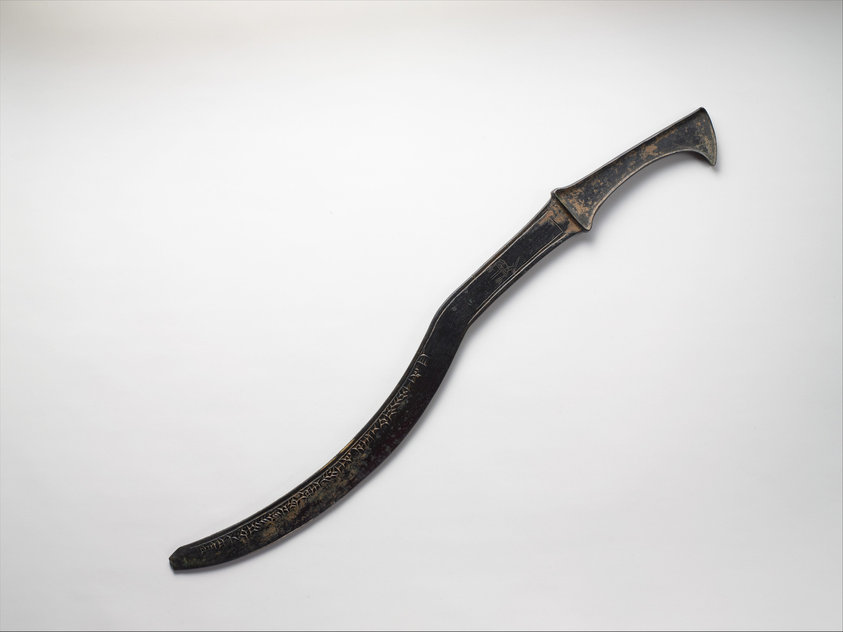
Sickle sword
Details
- Palette
-
Select a color to find related artworks.
- Medium
- Bronze
- Dimensions
- 2 13/16 × 21 1/16 × 1/2 in. (7.2 × 53.5 × 1.2 cm)
- Origin
- Assyrian
- Department
- Ancient West Asian Art
- Holding institution
- The Metropolitan Museum of Art
- Image provider
- metropolitan-museum-of-art
- License
- CC0-1.0
- Credit
- Gift of J. Pierpont Morgan, 1911
Art Genome Taxonomy
8 tags
Subject Matter
-
Animals Both · 84%
Animals are listed in the museum catalog as a subject, and a small figured motif is visible among the incised decoration on the blade, although its precise form is not fully legible.
Visual Qualities
-
Curvilinear Forms Visual · 98%
The blade follows a pronounced continuous curve, while the hilt and grip use opposing curved and swelling contours.
-
Single Object Visual · 99%
The photograph presents one isolated weapon against a plain, light-colored background.
Medium and Techniques
-
Etching/Engraving Visual · 80%
Fine incised lines, lettering-like marks, and figured decoration are visible along portions of the blade, consistent with engraving.
Time Periods
-
Ancient Art Metadata · 99%
The catalog dates the sword to approximately 1307–1275 BCE, placing it within ancient art.
Geographic Regions
-
Middle Eastern and North African Art Metadata · 88%
The catalog identifies the object as Assyrian and places it in the Department of Ancient West Asian Art, supporting a Middle Eastern geographic classification.
Materials
-
Bronze Both · 99%
The museum identifies the medium as bronze; the image shows a dark, weathered metal surface consistent with a patinated bronze object.
Antiquities, Artifacts, and Religious Objects
-
Arms and Armor Both · 99%
The museum classifies the object as a sickle sword, and the image clearly shows a long, curved blade with a distinct hilt and grip.
Source & rights
Unknown artist. Sickle sword. The Metropolitan Museum of Art.