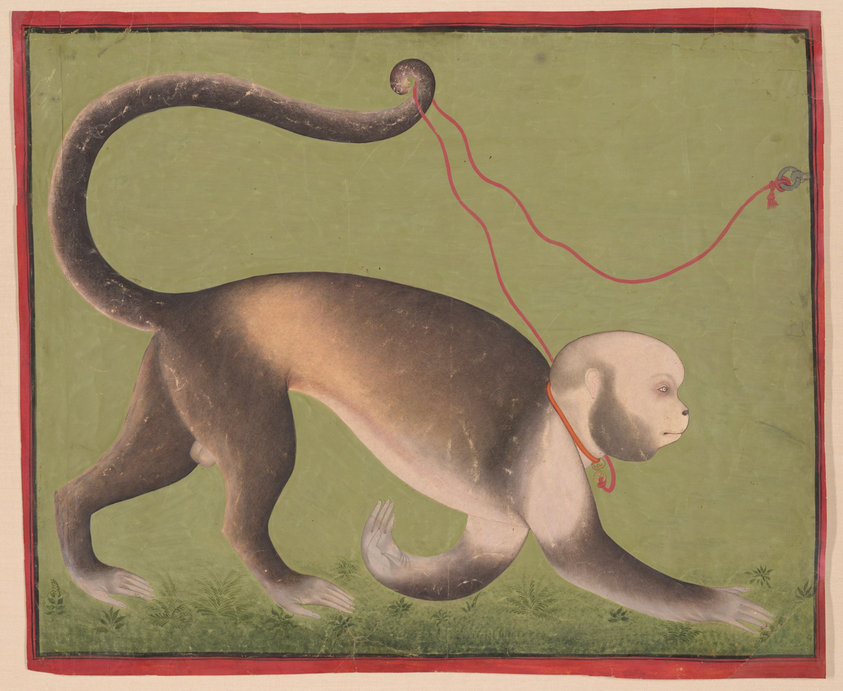
A Monumental Portrait of a Monkey
Except for depictions of the monkey-god Hanuman, monkeys are rarely the subject of portraits in India. In this monumental portrait, therefore, we are looking not only at an unusual subject matter but also at a study of an extraordinary simian: one with human features complete with a beard, pale eyes, and long, slender hands. The inscription on the back of this work, written in Devanagari, states that the monkey is named Husaini and “comes from” Nawab Davad (or Daud) Khan. This name most likely refers to Daud Khan Panni, a powerful nobleman and a faujdar (a military commander and territorial...
Details
- Palette
-
Select a color to find related artworks.
- Dimensions
- Outermost border: 48.5 × 58.7 cm (19 × 23 in.); Image: 45 × 56 cm (17 3/4 × 22 in.)
- Origin
- India
- Department
- Arts of Asia
- Holding institution
- Art Institute of Chicago
- Image provider
- art-institute-chicago
- License
- CC0-1.0
- Credit
- Lacy Armour Fund, James and Marilynn Alsdorf Acquisition Fund
Art Genome Taxonomy
11 tags
Subject Matter
-
Animal Portrait Both · 99%
A single monkey dominates the image as an individualized, portrait-like subject, and the catalog explicitly identifies the work as a portrait of a monkey.
-
Portrait Both · 94%
The isolated figure is presented in profile with distinctive facial and bodily features, while the catalog title identifies the work as a portrait.
-
Anthropomorphism Both · 86%
The monkey has an unusually humanlike bald face, beard, pale eye, and elongated hands; the catalog explicitly describes these as human features.
Visual Qualities
-
Curvilinear Forms Visual · 95%
The large tail forms a sweeping loop, and the red cord creates additional long, winding curves across the upper half of the composition.
-
Flatness Visual · 82%
A broad, largely uniform green ground and limited spatial recession emphasize the planar surface of the sheet, even though the monkey's body is modeled with tonal shading.
Medium and Techniques
-
Watercolor Metadata · 99%
The catalog specifies opaque watercolor and gold on paper; the image is visibly a layered painted work but its precise medium cannot be established from appearance alone.
-
Painting Both · 100%
The image is visibly a painted composition, and the catalog classifies the work as a painting.
-
Work on Paper Metadata · 99%
The catalog specifies that the work is made on paper.
Time Periods
-
18th Century Art Metadata · 96%
The catalog dates the work circa 1705–1710, placing it in the eighteenth century.
Geographic Regions
-
Indian Art Metadata · 99%
The catalog identifies the place of origin as India and specifies Rajasthan, Mewar, and Udaipur.
Materials
-
Gold Metadata · 95%
Gold is included in the catalog medium as part of the opaque watercolor and gold technique on paper.
Source & rights
India Rajasthan, Mewar, Udaipur, attributed to the “Stipple Master” (active c. 1692-c. 1715). A Monumental Portrait of a Monkey. The Art Institute of Chicago.