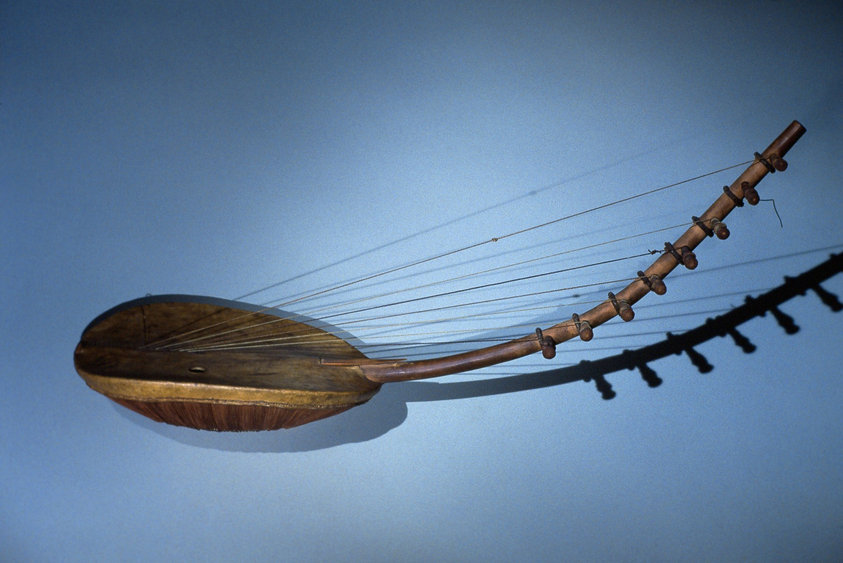
Ennanga
Details
- Palette
-
Select a color to find related artworks.
- Dimensions
- Height: 29 15/16 in. (76 cm) Width: 8 1/4 in. (21 cm)
- Origin
- Ganda people
- Department
- Musical Instruments
- Holding institution
- The Metropolitan Museum of Art
- Image provider
- metropolitan-museum-of-art
- License
- CC0-1.0
- Credit
- The Crosby Brown Collection of Musical Instruments, 1889
Art Genome Taxonomy
10 tags
Artistic Disciplines
-
Music Both · 99%
The Metropolitan Museum of Art classifies *Ennanga* as a chordophone-harp, and the image clearly shows a stringed instrument with a resonating body, curved neck, and tuning pegs.
Visual Qualities
-
Curvilinear Forms Visual · 99%
The neck forms a pronounced continuous curve extending upward from the rounded body, making curvilinear construction the dominant formal feature.
-
Slender Visual · 97%
The instrument has a markedly elongated profile, with a narrow neck and fine strings extending well beyond the broader resonating body.
-
Single Object Visual · 99%
The photograph isolates one complete instrument against a plain blue background.
Time Periods
-
19th Century Art Metadata · 99%
The museum dates the object to the 19th century, specifically within the supplied date range of 1801–1900.
Geographic Regions
-
African Art Metadata · 95%
The catalog records the place of origin or cultural attribution as the Ganda people, supporting its placement within African art.
Materials
-
Wood Both · 99%
Wood is listed in the catalog medium, and the body, neck, and tuning structure visibly appear to be wooden.
-
Natural Fibers Metadata · 88%
Vegetal fiber is explicitly listed in the museum's medium description, although its specific location is not visually identifiable.
-
Leather/Hide Metadata · 90%
The catalog lists snake skin and hide among the materials; the photograph shows a skin-like resonating surface, but does not independently establish the precise material.
Antiquities, Artifacts, and Religious Objects
-
Musical Instrument Both · 99%
The catalog identifies the object as a musical instrument, while the photograph visibly presents its body, strings, neck, and tuning mechanisms.
Source & rights
Ganda. Ennanga. The Metropolitan Museum of Art.