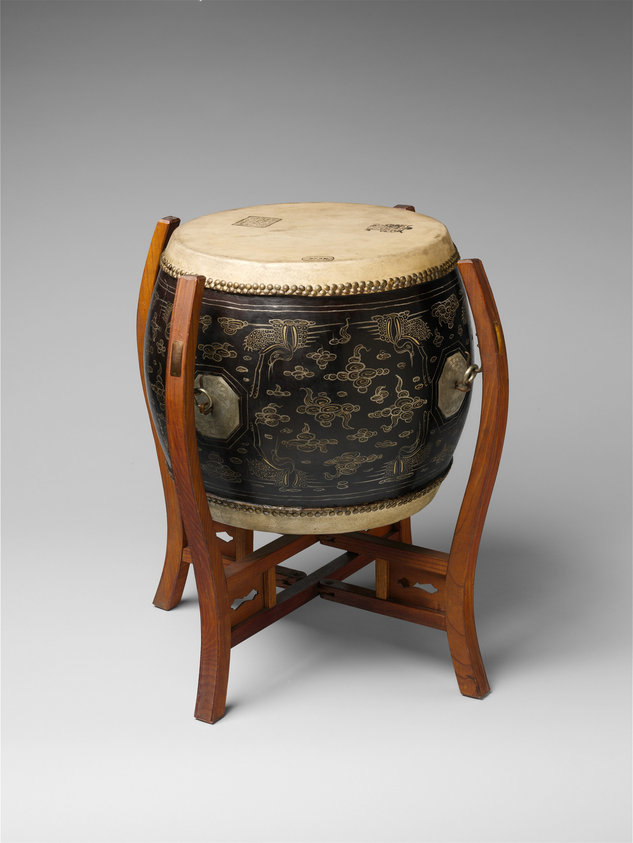
Tánggǔ (堂鼓)
Elevated Tone Workshop, Guangzhou (Canton)
Details
- Palette
-
Select a color to find related artworks.
- Dimensions
- Height: 22 in. (55.9 cm) Width: 22 in. (55.9 cm)
- Origin
- Chinese
- Department
- Musical Instruments
- Holding institution
- The Metropolitan Museum of Art
- Image provider
- metropolitan-museum-of-art
- License
- CC0-1.0
- Credit
- The Crosby Brown Collection of Musical Instruments, 1889
Art Genome Taxonomy
9 tags
Artistic Disciplines
-
Music Metadata · 98%
The catalog identifies the object as a musical instrument and places it in the Musical Instruments department.
Visual Qualities
-
Patterns Visual · 95%
The black shell is covered with repeated gold-toned cloud-like forms and other stylized decorative motifs distributed across its circumference.
-
Highly Ornamented Visual · 94%
The drum has dense decorative linework, repeated motifs, metal fittings, and multiple rows of fastening studs, producing an elaborate ornamental appearance.
Time Periods
-
19th Century Art Metadata · 99%
The catalog dates the drum to the 19th century, with a date range of 1801–1900.
Geographic Regions
-
Chinese Art Metadata · 96%
The catalog records the place of origin as Chinese and identifies the attributed workshop as Elevated Tone Workshop, Guangzhou (Canton).
Materials
-
Wood Metadata · 99%
Wood and teak are listed among the cataloged materials; the image visibly shows a wooden drum structure and support frame.
-
Leather/Hide Both · 98%
Oxhide is listed in the catalog, and the image clearly shows a pale hide drumhead stretched over the visible rim.
-
Brass Metadata · 97%
Brass is listed among the cataloged materials, and the image shows metal studs and fittings on the drum.
Antiquities, Artifacts, and Religious Objects
-
Musical Instrument Both · 99%
The catalog identifies the object as a Tánggǔ and a double-headed barrel drum, while the image clearly shows a large drum body, stretched hide head, fastening studs, and side fittings.
Source & rights
Elevated Tone Workshop, Guangzhou (Canton). Tánggǔ (堂鼓). The Metropolitan Museum of Art.