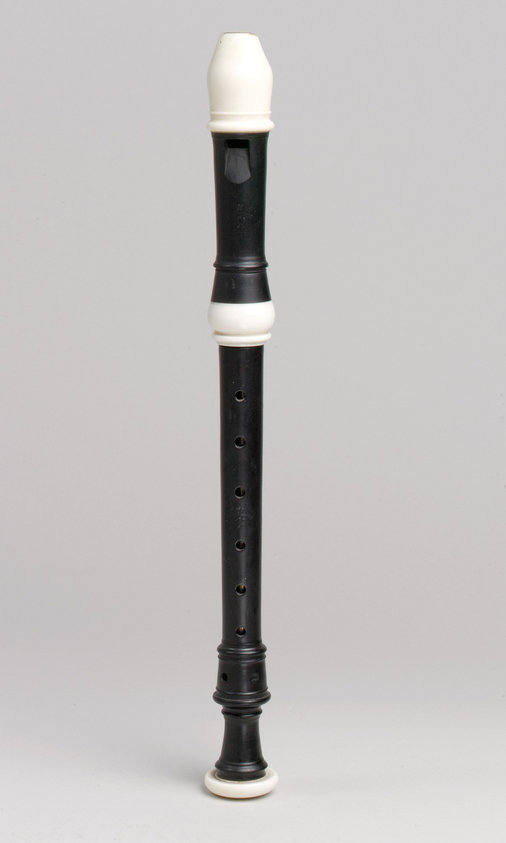
Soprano Recorder in B
Details
- Palette
-
Select a color to find related artworks.
- Medium
- Ebony, ivory
- Dimensions
- 13 1/8 × 1 5/16 × 1 5/16 in. (33.3 × 3.3 × 3.3 cm)
- Origin
- Dutch
- Department
- Musical Instruments
- Holding institution
- The Metropolitan Museum of Art
- Image provider
- metropolitan-museum-of-art
- License
- CC0-1.0
- Credit
- The Crosby Brown Collection of Musical Instruments, 1889
Art Genome Taxonomy
9 tags
Artistic Disciplines
-
Music Both · 99%
The Metropolitan Museum of Art identifies the object as a soprano recorder, an aerophone whistle flute; the image visibly shows a fipple mouthpiece, windway opening, finger holes, and an elongated tubular body.
Visual Qualities
-
Symmetrical Visual · 93%
The recorder is shown frontally as a largely axisymmetric object, with a straight central shaft, centered fittings, and regularly arranged holes.
-
Slender Visual · 99%
The instrument has a pronounced length-to-width ratio and a narrow cylindrical body.
-
Single Object Visual · 99%
The photograph isolates one recorder against a plain neutral background.
Time Periods
-
18th Century Art Metadata · 96%
The catalog dates the recorder to ca. 1700, which falls within the eighteenth century.
Geographic Regions
-
Dutch Art Metadata · 96%
The catalog lists the place of origin as Dutch.
Materials
Antiquities, Artifacts, and Religious Objects
-
Musical Instrument Both · 99%
The museum classifies the object as an aerophone-whistle flute-recorder, and its form is visibly identifiable as a musical instrument.
Source & rights
Thomas Coenraet Boekhout. Soprano Recorder in B. The Metropolitan Museum of Art.