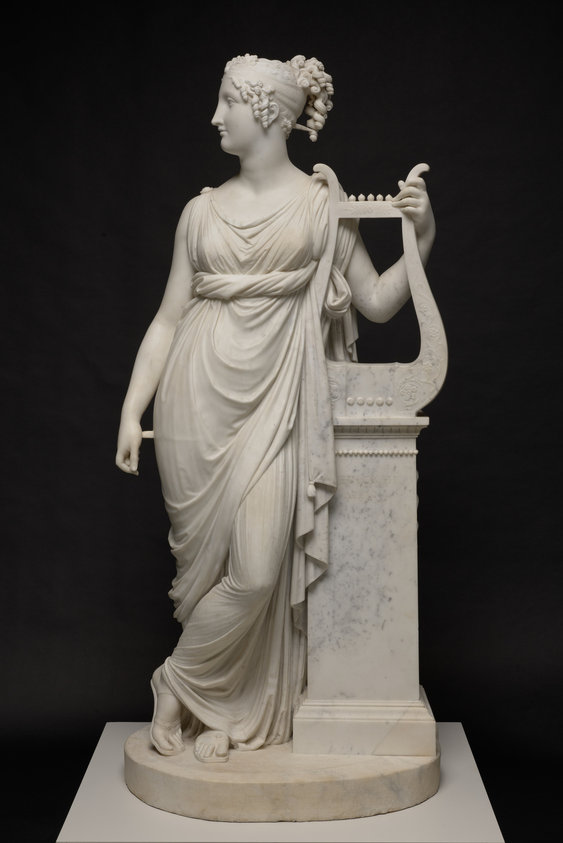
Terpsichore Lyran (Muse of Lyric Poetry)
In Greek mythology, Terpsichore was one of the nine Muses, or goddesses of creative inspiration. The lyre, the Greek inscription on the short column, and the caduceus (entwined snakes) on the side identify the figure as Terpsichore Lyran, muse of lyric poetry. This sculpture began with a commission from Napoleon's brother, Lucien, for an idealized portrait of his wife, Alexandrine. Antonio Canova made this version for a British aristocrat and exhibited it in 1817 at the Royal Academy in London to great acclaim.
Details
- Palette
-
Select a color to find related artworks.
- Medium
- marble
- Dimensions
- overall: height 1.775 m, width 0.781 m, depth 0.61 m; No Extent Specified: height 1.781 m, width 0.784 m, depth 0.613 m
- Origin
- Italy, 19th century
- Department
- Modern European Painting and Sculpture
- Holding institution
- Cleveland Museum of Art
- Image provider
- cleveland-museum-of-art
- License
- CC0-1.0
- Credit
- Leonard C. Hanna Jr. Fund
Art Genome Taxonomy
10 tags
Subject Matter
-
Classical Mythology Both · 99%
The Cleveland Museum of Art identifies the figure as Terpsichore, one of the nine Muses in Greek mythology; her idealized form, antique-style drapery, and mythological attributes are clearly visible.
-
Human Figure Visual · 99%
The image shows a single fully modeled standing human figure with detailed facial features, limbs, hands, and feet.
-
Related to Music Both · 96%
A large lyre is a prominent visual element, and the museum identifies the figure as the Muse of lyric poetry through this musical attribute and the accompanying inscription.
-
Contrapposto Visual · 87%
The figure’s weight is distributed asymmetrically, with a relaxed leg and a subtle shift through the hips and torso that produces a restrained contrapposto.
Styles and Movements
-
Neoclassicism Interpretive · 94%
The idealized anatomy, antique mythological subject, restrained pose, classical drapery, and refined marble finish strongly support a Neoclassical classification, although the supplied museum record does not list a style.
Visual Qualities
-
Highly Detailed Visual · 95%
The image shows finely resolved curls, facial features, fingers, sandals, ornamental lyre details, inscription, and numerous articulated folds of drapery.
Medium and Techniques
-
Sculpture Both · 100%
The museum classifies the work as sculpture, and the image shows a freestanding, fully three-dimensional figure, lyre, column, and base.
Time Periods
-
19th Century Art Metadata · 99%
The museum dates the work to 1816, placing it within the nineteenth century.
Geographic Regions
-
Italian Art Metadata · 99%
The museum identifies the place of origin as Italy and identifies Antonio Canova as Italian.
Materials
-
Marble Both · 100%
The museum identifies the medium as marble; the image shows a pale stone surface with subtle gray veining on the figure’s supports and instrument.
Source & rights
Antonio Canova (Italian, 1757–1822). Terpsichore Lyran (Muse of Lyric Poetry). Cleveland Museum of Art.